American Barn Owl
Scientific Classification
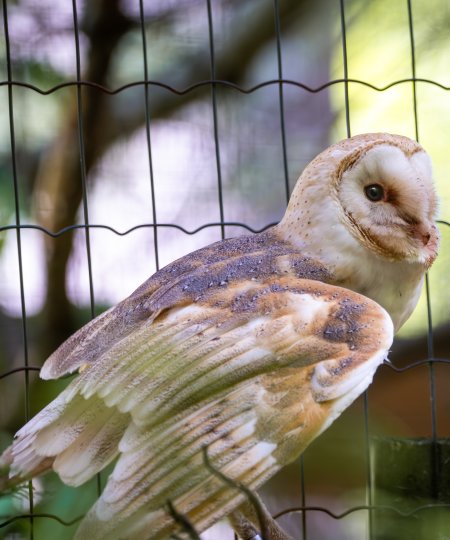
The American Barn Owl is a medium-sized hunting bird with an average wingspan of 110 cm (43 in). Females are larger than males, measuring 34-40 cm (13-16 in) in body length, while males range from 31-39 cm (12-15 in). It has a distinct heart-shaped facial disk, rounded wings, long legs, and a whitish underside and face that contrast with a speckled light brown backside and head.
The American Barn Owl is distributed throughout the Americas down to the southernmost tip of Argentina. As a nonmigratory bird that prefers temperate climates, its range in Canada is limited to southern Ontario and British Columbia. It is often seen in open areas such as marshes, grasslands, and forest edges at night, roosting during the day in quiet cavities like barns, tree hollows, and abandoned buildings.
The American Barn Owl has a diverse diet, which contributes to its wide distribution. While its primary food sources are small mammals, especially rodents, it can expand its diet to include birds, insects, and amphibians in areas where these prey are scarcer. Its digestive process includes the compaction and regurgitation of bones, fur, and other indigestible materials as an 'owl pellet'.
The American Barn Owl typically mates for life, with the male providing food to the female for a month before she lays eggs. Incubation starts as soon as the first egg is laid and lasts another month, with clutch sizes generally ranging from 4-7, though it can vary from 2-18. Owlets become fledge at 7-10 weeks old but will continue to rely on their parents for another 3-5 weeks. The American Barn Owl's lifespan averages 2-4 years in the wild, though many do not survive beyond their first breeding season.
The soft, serrated structure of an owl's wing feathers practically nullifies frictional noise generated from flight. It remains contested, however, whether this adaptation serves to mask the owl's noise from its prey for stealth hunting, or to enhance the owl's ability to hear its prey. Additionally, an owl's concave facial disk functions like a human ear by funneling sound towards the owl's ear openings.