
Open today 9:00 AM – 6:30 PM
Daily Last Entry 5:30 PM.
We will be open for Thanksgiving long-weekend!
We will be open for Thanksgiving long-weekend!

Our History
A brief history of the Shubenacadie Wildlife Park
1949
The earliest records of captive wildlife in what was to become the Wildlife Park show up in 1949, with three Chinese ring-necked pheasants being overwintered in a pen near the highway. The following spring over a hundred of their eggs were hatched and three orphan fawn deer joined the peasants in a separate pen. 1951 saw twenty one additional fawns coming to the site, two bear cubs, a pair of mature wildcats (bobcat), two fox pups, nineteen young raccoons, a pair of skunks, and a pair of beavers. This was getting attention, and families were stopping by to get a view.
1953
In 1953, land was acquired, roads
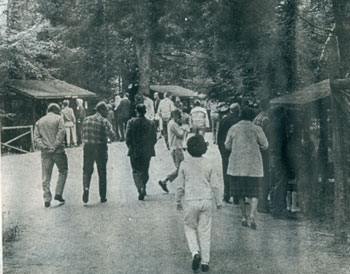
were built, fencing and enclosures were built. Ponds were created, swamps were cleaned. At this point the park was about 28 acres, and it retained a natural setting as much as possible. The Park was still in development when the volume of public interest was such that the gates had to be opened on 1 July 1954. In 1955, it was reported that 225,000 visitors came through, with as many as 12,000 in one day. (Hawbolt, Lloyd S., Sportsman’s Province, Sept 1956, pgs 15-17).

Though the park was the brainchild of G.W.I. Creighton, Deputy Minister of Lands and Forests from 1949 to 1969, Superintendent Eldon R Pace, was the driving force behind the park, devoting significant time and effort to the care of the animals. At that time breeding and rehabilitation activities were common at the park. Eldon was well regarded for his breeding of many bird species, some native species destined to be released, and other more exotic species to retain at the park.
1967
In 1967, Minister of Lands and Forest, E.D. Haliburton, added 156 acres to the Shubenacadie game sanctuary, which formed part of the Provincial Wildlife Park. This was primarily to provide protection to the animals being raised at the park, especially the birds. Hunters were coming too close.

Attendance numbers in the 1960s continued to be reported in the range of 184,000 to 233,000 visitors per year and the park size was variously reported as 400 and 1,600 acres. At that time admission to the park was free.
1977
In 1977, a Forest Environment Centre was built at the entrance to the park for a cost of $250,000. It commemorated 50 years since the formation of the Department of Lands and Forests. The five hexagonal pods constructed entirely of Nova Scotia wood housed interpretive displays, as well as park offices. The centre employed six guides during the summer.

1974-2000
For 26 years (1974-2000), the Wildlife Park hosted the Canadian Centre for Wolf Research. Up to fourteen wolves at a time lived with minimal human interaction, in a fenced enclosure of about 7 acres separate from the public area of the park. The primary purpose of the centre was to study wolf pack behaviour, leading to at least 120 scientific papers. Until 1996 it operated with grant from Dalhousie University.
Early 1990's
In the early 1990s, the park started charging fees to enter, initially for just the Wildlife Park, and then a few years later, the picnic park as well. The fees for a day were $3 per adult, $1 for youth six to seventeen years old and free for the under six. Season passes (May to October) were available at $25 for a family, $10 for an adult and $3.50 for youth. The fees haven’t gone much in the thirty years since they started, still cheaper than a movie and popcorn! The fees cover a portion of the cost of operating the park, with much of the rest funded by the parks owner, the Province of Nova Scotia.
2006
In 2006, Ducks Unlimited entered into a partnership with the Park, by raising the capitol to build the Wetland Centre (previously called the Greenwing Legacy Centre). Ducks Unlimited continues to maintain that partnership, primarily by co-delivering educational programs and events with park staff. This partnership has allowed the park to expand education beyond the wildlife in enclosures to much more of nature, including wetlands and ecosystems.
The legal status of the park has evolved over the decades. The most current is the 2008 designation of Shubenacadie Wildlife Park under the Wildlife Act, which sets the boundaries of the 331.46 hectare park. The Shubenacadie Wildlife Management Area extends beyond the park boundaries. The management area is to provide safety to the visitors to the Shubenacadie Wildlife Park.

Today, the park’s function continues to be to provide nature education to visitors, delivered by nature interpreters, park signage, guided tours and digital offerings. The park maintains a variety of trails (wildlife, wetland and marsh, as well as the picnic area.
Visitor Info
Know before you go
Getting here

General Admission Hours
Winter Months October 16 - May 14
9:00 am to 3:00 pm Weekends Only
Last entry: 2:00 pm
*Note: Some amenities close before the park gates
Summer Months May 15 - October 15
9:00 am to 6:30 pm
Last entry: 5:30 pm

Crown copyright © Province of Nova Scotia. All rights reserved.
