American Black Bear
Scientific Classification
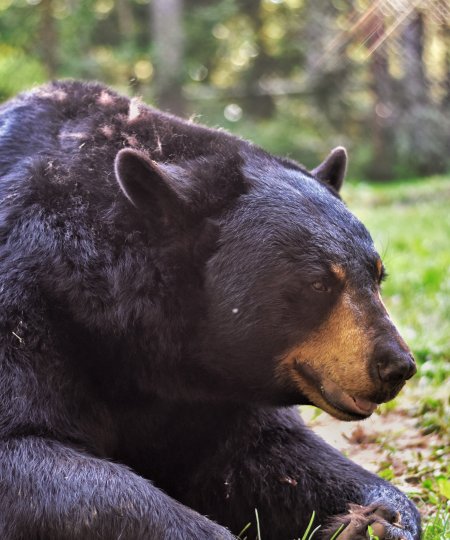
American Black Bears are medium-sized bears, with tan muzzles, small, rounded ears, and short, thick tails. While their coats are usually black like their namesake, their coat colours vary from black to brown, cinnamon, blonde, or even white. They are an average height of 0.75–1.0 cm tall at the shoulder when standing on four feet, up to 1.6–1.75m head-to-toe standing on two feet, and up to 1.25–2.1 m in length. Males are larger than females, with weights ranging from 60–250 kg, while females typically weigh between 40–70 kg. Their size and weight vary depending on their age and the time of year.
They are the most widely distributed bear species in North America, found throughout Canada, the United States, and parts of northern Mexico. In Canada, they inhabit every province and territory except Prince Edward Island, thriving in boreal forests, temperate rainforests, and mixed woodlands, with high populations in British Columbia, Ontario, Quebec, and the Maritimes. In Nova Scotia, Black Bears are the province’s largest land mammal and are found in forested regions across the mainland and Cape Breton Island, particularly in remote areas with abundant food and cover. They prefer densely wooded habitats, wetlands, and mountainous terrain, but are highly adaptable and can also be found near coastal areas, agricultural lands, and even suburban edges when searching for food.
They are omnivorous with a highly adaptable diet that varies by season and location. Their diet is primarily plant-based, consisting of berries, nuts, roots, grasses, and fruits, but they also eat insects, fish, small mammals, carrion, and occasionally young deer or moose calves. They are opportunistic feeders and will scavenge from human food sources, such as garbage and crops, when available. In spring, they consume fresh greens and insects, while in summer and fall, they focus on high-calorie foods like berries and acorns to build fat reserves for winter. Despite their size, Black Bears are skilled hunters and foragers, using their strong claws to dig for roots, tear apart logs for insects, and catch fish in streams.
Cubs are born inside the den during hibernation in January or February, weighing less than 500 g and completely dependent on their mother. The mothers nurse and care for their cubs in the den until spring, when they emerge and begin learning to forage. Cubs are weaned at 8 months old, but they stay with their mothers for about 1.5 years, hibernating with their mothers during their second winter, after which they disperse to find their own territories and become independent. They reach sexual maturity at 3 to 5 years old, with females typically giving birth every 2–3 years after a successful mating season in late spring to early summer. They live solitarily, only coming together to mate in the spring in June and July, with gestation lasting 220 days. In the wild, Black Bears can live 15–25 years in the wild, and up to 30–40 years in captivity.
Black Bears have strong, curved claws which allow them to climb trees to escape predators, find food, and rest. Their powerful limbs allow them to run at speeds of up to 56km/hour and their strong swimming ability make them highly mobile, allowing them to traverse forests, mountains, and rivers with ease. They have an excellent sense of smell, helping them locate food from great distances. Their omnivorous digestive system enables them to eat a wide variety of foods, allowing them to survive in different habitats. During the summer and fall they enter a state called hyperphagia where they consume 15,000–20,000 kcal/day to build up energy reserves for hibernation. During hibernation they lower their body temperature to 33 °C, their heart rate to, 8–21 beats/min, respiratory rate to 1 breath/15–45 sec, and suppress their metabolism by 75% to reduce their energy needs. They use 4,000 kcal/day, surviving off their fat reserves, losing at least half their body weight. While often referred to as hibernation, Black Bears actually enter a unique state known as torpor, where they can still wake up easily if disturbed and even give birth, unlike true hibernators like chipmunks. They have thick fur for insulation in colder climates and a layer of fat that helps sustain them during hibernation. They experience delayed implantation, meaning the fertilized egg does not attach to the uterus until fall, ensuring the mother has enough fat reserves to support the pregnancy.