American Bullfrog
Scientific Classification
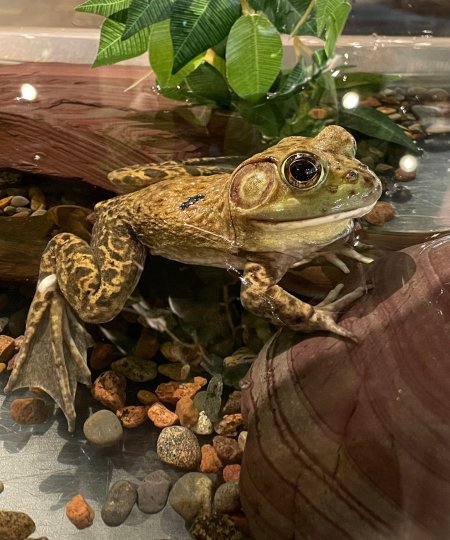
The American Bullfrog is a large frog species with smooth, green to brownish skin with darker spots or mottling, while their undersides are typically lighter, ranging from white to yellow. They have a broad, flat head, with golden or yellow eyes, and a wide, muscular body that can reach up to 16–20 cm in length and 750 g in weight. Their long, powerful hind legs are adapted for swimming and jumping, with webbed feet for better propulsion in water. Adult males have a larger external ear known as a tympanum, compared to females, which helps amplify their calls. Tadpoles have a dark–olive brown or black body and a flat, rounded tails with eyes on top of their heads.
Bullfrogs are widely distributed across North America, found throughout the United States, southern Canada, and parts of northern Mexico. In Canada, they are found primarily in the southern regions of Ontario, Quebec, and parts of the Maritimes, where they thrive in warm, shallow bodies of water such as ponds, lakes, marshes, and slow-moving rivers. The species prefers wetland environments with abundant vegetation, which provides cover and hunting opportunities. In Nova Scotia, they have established populations in areas with little predation or human disturbance such as the Eastern Shore, the Annapolis Valley, and Cape Breton.
As tadpoles Bullfrogs are primarily herbivorous during their early stages, feeding on algae, aquatic plants, and decaying organic matter and later small invertebrates as they transition into carnivores. Bullfrogs are carnivorous and opportunistic feeders, known for their voracious appetite. Their diet primarily consists of insects, such as crickets, beetles, and grasshoppers, as well as aquatic invertebrates like snails and worms. Bullfrogs also consume small fish, tadpoles, other amphibians, and occasionally small mammals, birds, and reptiles if the opportunity arises. They are skilled hunters and use their quick, sticky tongues to capture prey, often ambushing them while sitting still near the water. Their large mouths allow them to ingest whole prey much larger than their own size, including young ducks or small rodents. They will try to eat anything that fits in their large mouth, eating prey that are almost half of their body size. When they swallow, they retract their eyes into their skull to help push food down their throat.
They breed during May-July where the males call to attract females primarily at dusk and at night. Females produce 1–2 clutches/year which hatch in 4–20 days. Eggs are laid on the surface of the water, typically in large floating clusters of 5,000-20,000 black eggs with a gelatinous coating. After about 3–5 days, the eggs hatch into tadpoles, and they stay in tadpole form for 1–3 years reaching up to 15 cm long. Then the tadpoles undergo a rapid transformation known as metamorphosis over 3–4 months where they develop hind legs, then front legs, and their tails shorten as they become juvenile Bullfrogs. Juvenile Bullfrogs are fully formed by late summer, but they remain in the water for up to 1–2 years to grow before becoming sexually mature. They reach full maturity by 2–5 years of age and can live up to 7–10 years in the wild.
The powerful hind legs of the Bullfrog allow them to jump up to 2 m to escape predators. Their webbed feet help them swim efficiently in both still and slow-moving waters. Their bulging eyes on top of their head allow them to remain almost entirely submerged, keeping a low profile while still being able to see above the water. They have a wide mouth and a large gape, allowing them to catch and swallow large prey. Their sticky tongue can launch out of their mouth in less than 0.7 seconds to strike and capture prey. Their skin secretes a mild toxin as a chemical defense mechanism. When they are being preyed upon, they can emit a loud, high–pitched scream to startle their would-be predator. Unlike some other amphibians, Bullfrogs do not undergo true hibernation. Instead, they enter a state known as brumation during the colder months. Brumation is a form of dormancy like hibernation, but it's less deep, and their metabolic rate slows significantly. They enter brumation in late fall as temperatures drop, and they remain inactive through winter until spring warmth returns. They usually seek muddy bottoms of ponds, lakes, or streams, where the water doesn't freeze and burrow into the mud or hide under rocks or debris to stay warm and protected. While in brumation, Bullfrogs are inactive but can still move if disturbed. They can breathe through their skin and rely on stored body fat to survive the winter. As temperatures rise in spring, their metabolism speeds up, and they emerge from brumation to resume their normal activity, feeding, and mating.