American Kestrel
Scientific Classification
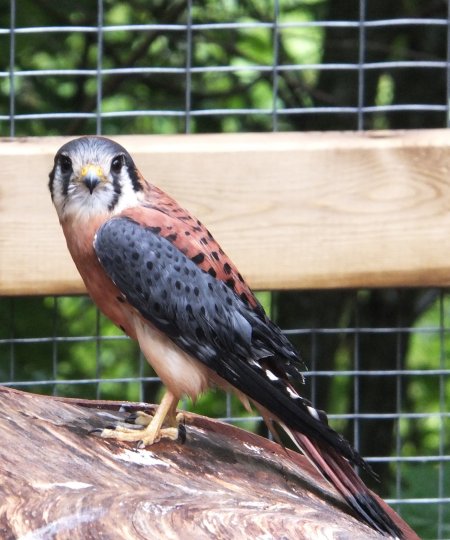
The American Kestrel is a small, colourful raptor with a body length of 25 cm (9.85 in) and a wingspan of 56 cm (22 in). Males feature a prominent ashy-blue head and wings and a reddish-brown back and tail, while females display this reddish-brown on the wings, back, and tail. Both sexes have two distinct black slashes running down the sides of their white face.
The American Kestrel is a small, colourful raptor with a body length of 25 cm (9.85 in) and a wingspan of 56 cm (22 in). Males feature a prominent ashy-blue head and wings and a reddish-brown back and tail, while females display this reddish-brown on the wings, back, and tail. Both sexes have two distinct black slashes running down the sides of their white face.
Primarily eats insects, especially grasshoppers, crickets, and beetles during warmer months, but can also feed on small vertebrates such as mice, frogs, snakes, and birds. This diverse diet allows it to survive in a variety of environments and adapt to seasonal changes in prey availability.
The American Kestrel typically lays 4-6 eggs in one brood, but may lay as few as 2 or as many as 7. American Kestrels raise one to two broods per breeding season, with both parents sharing incubation duties, which usually lasts for 28-31 days. Hatchlings are born feeble and helpless (altricial), and must be cared for by their parents for one month before leaving the nest cavity as fledglings.
The American Kestrel’s head markings include two false eye spots on the back of the nape to confuse potential predators. When hunting, the kestrel is able to hover nearly motionless against the wind for over a minute due to a combination of stamina, specialized physical features, (such as long tail feathers), and precise control of its body movements. It also uses its ability to see ultraviolet light to track urine trails left behind by prey.