Axolotl
Scientific Classification
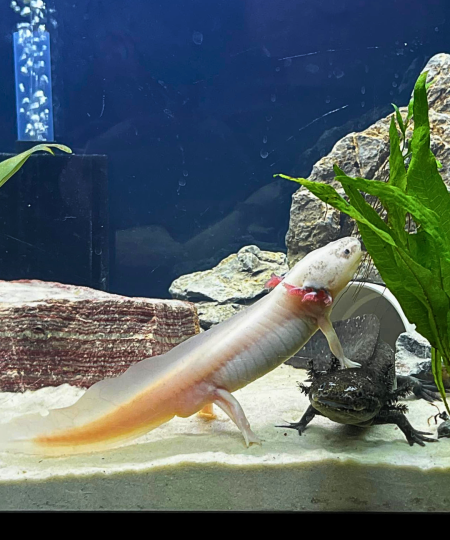
Adult Axolotls reach an average length of 20cm (8 inches), but can become as long as 30 to 45cm (12 to 18 inches). They can weigh anywheres from 60 to 140 grams (2 to 5 ounces), with a select few reaching masses of 300 grams (10.5 ounces). Axolotls in the wild have a dark brownish-green mottled pattern to their body. Captive Axolotls have been bred to have other colourations, with one of the more popular colourations being their whiteish-pink Leucistic version. Their heads are slightly flatted, and sport a thin mouth and lidless eyes that some could perceive as looking cute. The most notable aspect of Axolotls are the fact that they look a lot like an adult version of a salamander larva; for a start, they sport a set of 6 external, feathery gills on the sides of their head for acquiring Oxygen from the water. They additionally have a large finned tail to aid in swimming, yet also possessing a functional set of four legs. This is a phenomena known as Neoteny, where a species of animal retains a number of juvenile traits into adulthood, in this case the previously mentioned gills and finned tail.
The distribution of Axolotls are extemely limited; they are only found in one high-altitude lake, Xochimilco Lake, just on the outskirts of Mexico City. They were previously found in another high-altitude lake near Mexico City known as Lake Chalco. Unfortunately, since the arrival of Spanish conquistadors, this lake was drained to the point where it no longer exists. Because of their extremely restricted range, they are considered Critically Endangered in the wild. The type of habitat that they are confined to are isolated high-altitude lake systems, whose waters do not rise above 20ºC. They usually prefer to hide underneath plants or rocks. The high-altitude status of Lake Xochimilco and its lack of native predators are thought to be the main contributing factors for Axolotls evolving to be Neotenous.
Barring Birds and Invasive Fish Species, Axolotls are considered a top predator in their environment. They will consume whatever they can catch and fit into their mouths; this includes Arthropods, Molluscs, Worms, Tadpoles, smaller Fish species and even other Axolotls. They will attempt to catch food through a process called buccal feeding, where similar to fish, they will rapidly expand the inside of their mouths, resulting in nearby objects being vacuumed straight in.
The Axolotl breeding season occurs during the spring season. Courtship usually involves both parties nudging each other and circling each other in a dance-like fashion. Similar to other Salamanders, once the male successfuly courts a female, the male Axolotl will deposit a jelatinous mass of sperm known as a spermatophore, which the female will then use to fertilize her eggs. The female Axolotl will lay between 100 to 300 eggs, which are sheathed in a protective gelatinous coat and attached to a substrate such as vegetation or rocks. In two weeks, the eggs will hatch into larval Axolotls that will begin their life fending for themselves. The Larval Axolotls lack legs upon hatching, but they will grow in over the course of their first month. It will take about a year for an Axolotl to attain sexual maturity; in the meantime, they must avoid being predated on by Birds or cannibalized by larger Axolotls. Invasive Fish Species introduced to Xochimilco also pose a threat to Axolotls. In a laboratory setting, Axolotls in the wild tend to live for 15 years, though captive ones have been known to live for longer, up to 25 years.
Their Neotenous nature means Axolotls are confined to the water for the entirety of their lives. In addition to using their sight and sense of smell to navigate in their environment, they can also detect electric fields, allowing for them to more easily find prey and perceive threats. As interesting as their other adaptations are, Axolotls are most renowned for their regenerative properties. They have the ability to regenerate their gills, legs, tails, and even parts of their eyes, hearts, spine and brain. When injured, progenitor cells develop at the site of the injury, and growth-promoting proteins eventually provide instructions for the cells to develop into the tissues required for the injured body part. They can even easily accept limbs transplanted from another Axolotl. As a result of their sophisticated regenerative abilities, Axolotls are frequently utilized as laboratory animals in order to understand the developmental biology of Vertebrates.