Barred Owl
Scientific Classification
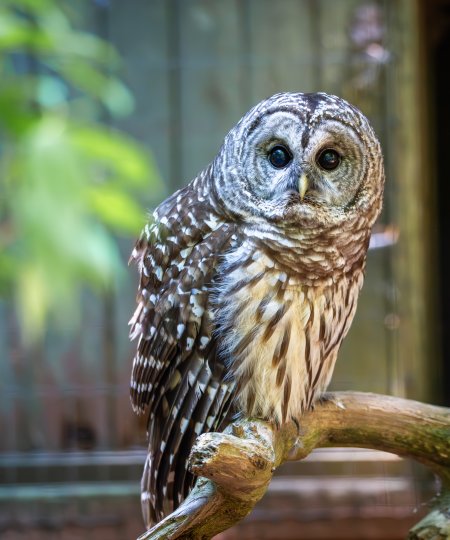
Barred owls are considered a large owl species at 43-55cm (17- 22 inches) in length. They are greyish-brown in colour with barring across the upper breast and neck and streaks running down the body. Eyes are dark brown and closely set. The bill is straw-yellow. Females are larger than males. Females get up to approximately 2.5 lbs while males max out at 2 lbs.
They live in mature forests, preferring mixed woods near water and fields. It is likely that old growth forests provide more of the nesting habitat that they require as well as more shelter from the elements and potential predators. They are not confined to mature forests and have adapted to semi-open wooded areas, parks and suburban areas that have large trees. They prefer to nest in tree cavities, but will use large stick nests of other birds. Barred owls are found across Canada, the eastern United States, and as far south as Mexico.
Because they have weak talons, barred owls hunt small prey, such as voles, shrews, frogs, salamanders, fish, insects and snakes. They are also known to be opportunistic and will prey on other birds and reptiles.
Barred owls usually mate for life and breed from February to June but peaking in February to March. They lay between 2-4 eggs in March to April, which hatch after about 4 weeks. Both parents hunt for young until they are 6 weeks. By then adult feathers have started to grow. Short flights start at 10 weeks old with longer flights taking place at 14 weeks. By mid-Autumn, the young are ready to leave as parents feed them less and less. Life expectancy is just about 20 years in the wild and up to 30 in captivity, with the oldest recorded in captivity being 34 years old.
All owls have special adaptations for night hunting. Their eyes can function in low light conditions and their hearing is amplified by the shape of their head. The leading edges of their flight feathers have a frayed edge that allows them to fly virtually soundless. This adaptation not only conceals them from prey, but allows them to hone in on the sounds of prey without distraction. Females lose the feathers on their belly so that her warmth can easily be transferred to her eggs. This is called a brood patch.