Beaver
Mi'kmaq Name: Kopit (pronounced go-bit)
Scientific Classification
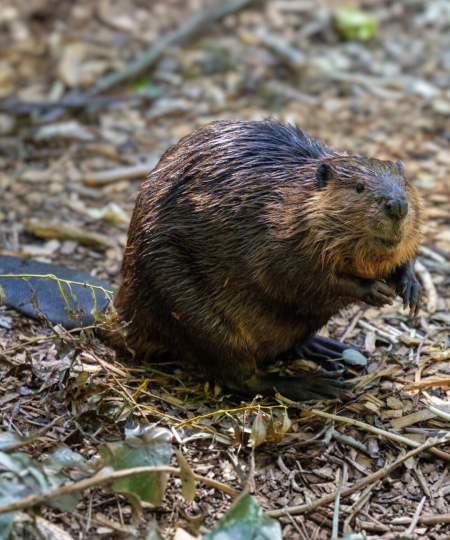
Beavers are the largest living rodent in North America and second largest living rodent after the Capybara. The mass of a Beaver is usually 13 to 32kg (28 to 70lbs) and their size can range from 90 to 137cm (35 to 54 inches). Their body is covered in a reddish-brown to dark brown coat of fur, with finer dark grey underhairs. They have a large head with small round ears. Their enlarged incisors (front teeth) have a unique orangey coloured hue to them. The most signature feature of a beaver is it's paddle-shaped tail, which is covered in large black scales.
Beavers are found throughout most of the North American continent, with the exception of desert ecosystems such as Northwestern Mexico and the Southwestern US, as well as the polar regions of Canada and Alaska beyond the treeline. As an aquatic mammal, Beavers are found in water habitats such as river and lake systems as well as wetlands. Beavers are known to be an eco-engineer, meaning they are capable of significantly altering their environment. The construction of their dams, which are meant to provide a flooded area for their lodge and for foraging for food, can convert forested biomes with fast-flowing rivers into open wetlands and floodplains.
Beavers are herbivorous, with the bulk of their diet consisting of tree bark and the layer of plant tissue underneath the bark known as cambium. Beavers will additionally feed on aquatic vegetation, roots, leaves and plant buds. Microorganisms that reside in their gut aid in the processing of the cellulose that is contained in the consumed plant material.
Beavers are monogomous, staying together as a mated pair for the duration of their lives, though if one of the Beavers die, then the other one will search for a new mate. In Canada, Beavers will mate during the winter months between January and March each year, while those in the southern parts of the North American continent mate earlier. The gestation period is about three months, after which the female will birth a litter of 1 to 4 kits, but can be as many as 9. These kits are born with fur and sight, and are able to begin swimming within the first day of being born. The kits will stay within the lodge for most of their first month of life, after which they will begin to explore outside of their home. Kits are often weaned off of their mother's milk within the first two weeks following their birth, but this process may take as long as three months. After their first year, the kits are old enough to aid in caring for any new kits that the parents give birth to, as well as assisting in foraging for food and building material. After two years, the offspring are forced to leave their parent's lodgings and establish their own territory, allowing for the parents to rear another litter. Beavers reach sexual maturity during their third year. Beavers have a lifespan that ranges from 10 to 20 years. Beaver kits are particularly vulnerable to predation, specifically from wolves, bears, lynxes and large mustelids such as wolverines, fishers and otters. Adult Beavers are not predated on as frequently.
The most iconic behavioural adaptation of a Beaver is their ability to construct elaborate aquatic lodges for their shelters, as well as dams that help facilitate their waterborne lifestyle. The lodges have underwater entrances that the Beavers use to enter and exit from, and are constructed using branches, sticks and moss, with mud acting as the mortar for the construction. The same materials are used for dam construction as well as stones and rocks. Beavers do not hibernate, so they collect additional foliage before winter and store them underwater. The cached foliage is effectively refrigerated under the ice that forms over the lake or pond, providing a source of food for the Beavers until spring returns. Beavers are primarily nocturnal, but will also be active during the dawn and dusk hours of the day. The beaver possesses a number of physical adaptations that aid it in its aquatic activities. This includes its closable nostrils and ears, webbed hind feet and nictitating third eyelid, which is a special clear eyelid that protects the beaver's sight while submerged in the water. By using their specialized lungs and by lowering their metabolism, Beavers can hold their breath for up to 15 minutes whilst underwater. The beaver's flat tail aids in swimming, making alarm signals by slapping their tail against the surface of the water, and balancing itself when carrying logs and branches, and female beavers can additionally use their tails as a birthing mat for their newborn kits. They also possess two sets of glands near the base its tail; the castor glands for marking their scent, producing a pungent yet sweet smell, and oil glands that the Beaver uses on their fur to act as a protective hydrophobic coating. This oils are applied by using a special set of grooming grooming claws on their hind legs.
In Mi'kmaq culture, the beaver is highly valued for its fur to make clothing and its meat for food. The Beaver is one of the Mi'kmaq Seven Sacred Teachings representing Wisdom. It is respected as a skilled builder and teacher while reminding us to use our gifts to build, adapt, and live in balance with the land and water.
Beavers are considered "Eco-Engineers" due to their ability to vastly alter their surrounding landscape, converting forested areas into open wetlands. Other examples of eco-engineering animals include coral, elephants, termites, and of course humans.
Beavers are considered a keystone species for wetland habitats as they contribute greatly to the health of these ecosystems; their ponds act as vital nesting sites for wetland birds and nurseries for freshwater fish and invertebrates. The wetlands they create also aid in reducing erosion and filtering out any minerals or toxins, purifying the water.
The Beaver's castor glands produces a secretion known as castoreum, which is sometimes used in perfumes and fragrances due to the sweet smell.
The shape of a Beaver dam is based on the speed of the river or stream where they plan to begin their construction; the faster the flow of the river, the more curved the dam's shape. The curved shape provides stability and prevents the dam from collapsing by the force of the water.
The Beaver's incisor teeth have an iconic orange hue to it; this is due to the enamel containing a high amount of iron, which enhances their ability to gnaw through wood.