Black Vulture
Scientific Classification
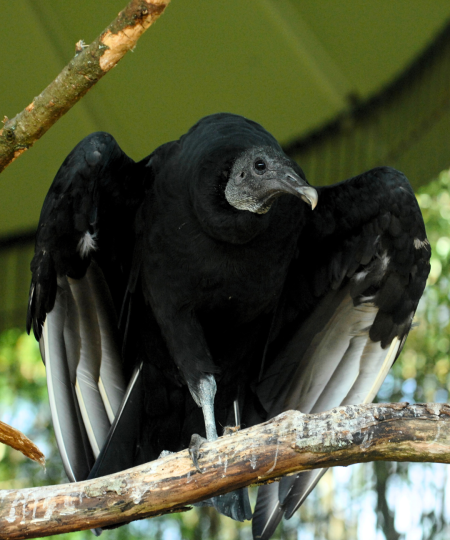
The Black Vulture is a large bird of prey measuring 56-68 cm (22-27 in) long. As the name suggests, its most distinctive feature is its black feathers which contrasts against a gray, scaly, bald head. It has broad, fingered wings that span about 1.4 meters (59 in) and have white tips on the underside. The Black Vulture can be distinguished from its relative, the Turkey Vulture, by its head (larger, gray vs. the Turkey Vulture's red) and smaller, stockier build.
The Black Vulture prefers environments with open areas for hunting and wooded areas for roosting and nesting, such as forest edges, wetlands, and fields. The Black Vulture can also live near human settlements, especially garbage dumps, where it scavenges discarded food. Its range spans from New England down the Eastern United States to Chile and Argentina, as well as throughout much of Central and South America.
The Black Vulture's diet consists mostly of carrion (dead animals) of various sizes, from skunks to cattle. However, it will opportunistically prey on eggs and newborn animals as well. The Black Vulture feeds in groups, gorging itself due to competition from other vultures and the unpredictable availability of carrion.
The life cycle of the Black Vulture is defined by family bonds - breeding pairs are monogamous and bond for life. Rather than building a nest, it lays a clutch of 1-3 eggs directly on the ground in a dark, enclosed space (cave, tree hollow, thicket, etc.), with hatching occurring after 5-6 weeks. Parents will continue to care for their young for up to 8 months after fledgling at 6-7 weeks, after which the offspring can continue to forage with their family as a flock.
The Black Vulture's bald head was long thought to maintain cleanliness while feeding on carrion, but it may also help regulate its body temperature. In addition to this adaptation, its highly acidic stomach acid (pH = 1) and antimicrobial microbes on its face and in its digestive system allow it to safely consume decaying meat without getting sick. The Black Vulture hunts by sight, which can make finding carrion difficult as it doesn't move. When it does find food, it circles above to signal other vultures to gather, reducing competition from other predators.