Blandings Turtle
Scientific Classification
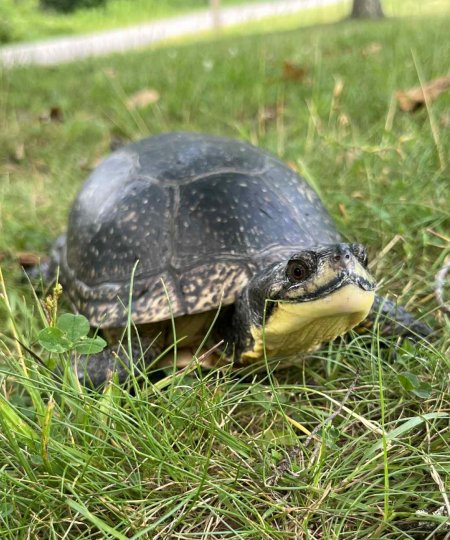
Medium-sized turtle with smooth dome-shaped shell. Shell is dark brown to black with yellow spots and streaks. Well known for its bright yellow chin and throat. Its head is brown and black with yellow flecks. Females have short tails while males have larger, more prominent tails. Males also have a concave shaped plastron that allow them to sit comfortably atop females during mating.
There is an disjunct population population of Blanding's turtles in Nova Scotia but most of the Canadian population exists in Southern Ontario and Quebec. It is also found in central United States. Preferred habitat includes wetlands, beaver ponds and shallow lakes with adequate vegetation and muddy substrate. Blanding's turtles may travel several kilometers between their summer habitat where they feed and mate, to their winter habitat where they hibernate.
Blanding's turtles are largely carnivorous, feeding on crayfish, frogs, snails, fish, fish eggs, insects, tadpoles, earthworms, slugs, grubs, and even carrion. They capture their prey by sucking water into their mouth. At times and during the season, they will eat berries, seeds and leaves.
Blanding’s Turtles emerge from brumation in March or April. Those that emerge in March may not feed until April. They remain active until September or October. During spring, males relentlessly pursue females in the water and will even follow her onto the land. Females seek their nests to lay 6-16 eggs (up to 25) in late May to early July. They look for open areas with high sun exposure such as forest clearings, meadows, shorelines, agricultural clearings and even roadsides. Ideal substrate includes soft sand, soil or gravel and are less than a hundred meters from water. Females leave their eggs to hatch on their own. It takes these turtles up to 25 years to reach sexual maturity, and females only reproduce every 1-3 years. They are a long-lived species, with a life expectancy of 77 years or more.
Brumation is an essential part of the turtle's life cycle and its ability to lower its metabolism facilitates this. As temperature falls, so does its metabolism, allowing it to survive in conditions that are low in Oxygen. Metabolosm can fall lower than a mere 5%. Additionally, Blanding's are able to perform gaseous exchange across their cloaca, gaining the oxygen required to keep their cells supplied. Blanding's also estivate. That is, they are able to go into a state of dormancy in extremely hot conditions thereby preventing overheating and waterloss. Their webbed feet make them agile swimmers making them able to catch a variety of aquatic fauna such as fish and crustaceans.