Canada Goose
Scientific Classification
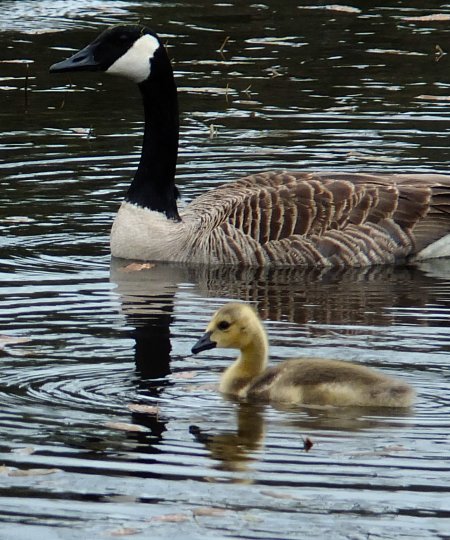
The Canada goose is very easy to identify with its long black neck, black head, and white cheek patches. Several different races of Canada goose have been recognized. The four smallest races, or subspecies, have now been categorized as a separate species, the cackling goose (Branta hutchinsii). The remaining seven races can be differentiated by small variations in the shape, size and proportion of the bill and head. Body weight ranges from 3-9 kg (7–20 lbs) and wingspan from 1.3-1.7 m (50-68 inches).
There are populations of Canada geese all across North America, from the treeless arctic tundra to the southern United States. Canada geese are well known residents of nearly all types of wetlands, as well as municipal park and beach areas. Overwintering occurs from areas of the central USA to southern Mexico and along the Gulf Coast. Characteristic V shaped flocks of migrating Canada geese are a very common sight and sound all across Canada every spring and fall. Flying as many as 1000 km (620 miles) per day, they can be found by the hundreds in fields and wetlands, resting and feeding during their semi-annual trip.
Herbivorous, Canada geese eat a variety of plant species, particularly aquatic plants, grasses, sedges, grain, and berries.
Pairs of Canada geese mate for life, but if one is killed, the other will take a different partner. Returning to the same area, often the very same nest, year after year, mated pairs nest on land, near the water, and often prefer islands. The female goose sits on the eggs while the male stands guard nearby. Goslings (baby geese) hatch after an incubation period of 25-28 days. During the last few days inside the egg, they communicate with their parents via tiny peeps and trills. Early spring nesters, Canada Geese goslings will be hatched and ready to feed when the new vegetation is most nutritious. Goslings will remain with their parents for a year and usually start reproducing at 2-3 years of age. Canada geese are protective of their young and can be aggressive.
The Canada Goose is adapted to extract maximum nutrition from its herbivorous diet. Its long neck contains a crop that can store food temporarily, essential for their long migratory flights. Its feet and legs are adapted for its life on the land as well as in the water. Webbed feet allow efficient movement in water, while powerful legs support walking, running and taking off for flight. Its respiratory system, coupled with its highly effective circulatory system, facilitates its lengthy migrations enabling flight at altitudes of 9,000 feet. Unidirectional airflow through the lungs provides continuous supply of oxygen to essential flight muscles for prolonged periods. Their bones are hollow and filled with air-sacs, yet strong, making the bird light and able to fly with minimal effort.