Cheer Pheasant
Scientific Classification
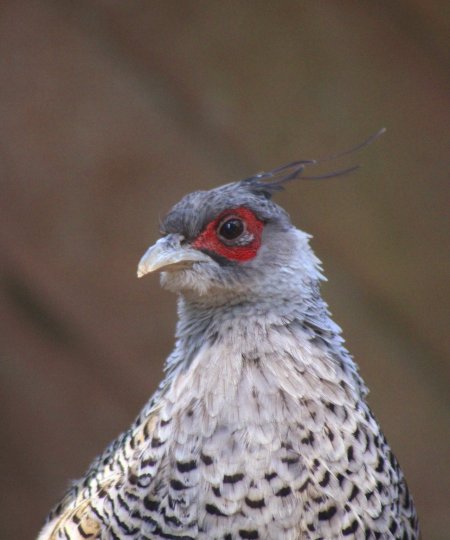
Cheer Pheasants are a large, ground-dwelling bird with relatively muted but attractive plumage. Males and females have similar coloring, with grey-brown bodies, fine black barring, and long, pale tails with dark cross-stripes. Males are slightly larger and may have a subtle crest and more pronounced facial markings. Adults typically measure 110–135 cm in length, much of which is tail, and weigh between 1.5–2.5 kg. Their overall coloration blends well with grassy slopes, making them difficult to spot in the wild.
They are native to the western Himalayas, including parts of northern India, western Nepal, and Pakistan. They inhabit steep, open hillsides, grassy slopes, and shrubland between 1,500–2,700 m in elevation, often in areas grazed by livestock. Unlike migratory or wide-ranging birds, Cheer Pheasants are strongly tied to a specific area, often living their whole lives on a single hillside or slope if undisturbed. In Canada, they do not occur in the wild but are occasionally kept in captivity for ornamental or educational purposes.
They are omnivorous foragers, feeding on a mix of seeds, roots, grasses, berries, insects, and small invertebrates. In the wild, they scratch through leaf litter and soft soil with their feet to uncover food. Their diet shifts seasonally based on availability. In captivity, they are typically fed a balanced game bird diet, supplemented with leafy greens, grains, and occasional fruit or insects to mimic their natural intake.
Breeding season in the wild typically occurs from April–June, when pairs form and the females build shallow nests on the ground, usually hidden in tall grass or under a shrub. Females lay 9–14 eggs, which they incubate alone for about 26–28 days. Chicks are precocial, born with feathered down and the ability to walk, and can leave the nest shortly after hatching and feed themselves within hours but remain with their mothers for several weeks. Sexual maturity is reached at 1–2 years. While monogamous pairs are the norm in spring, in fall and winter they may form small flocks made up of related individuals or juvenile birds. In the wild, Cheer Pheasants are thought to live 5–7 years, though exact data is limited due to their elusive nature. In captivity, with proper care, they can live 10–12 years or more. The oldest known individual reportedly lived to be over 13 years old in managed care.
Cheer Pheasants are adapted to life on steep, rugged terrain, with strong legs and feet for climbing and scratching through vegetation. Their muted, barred plumage provides excellent camouflage against dry grass and rocky soil. They are reluctant fliers and usually prefer to run or hide when threatened. They will hide by crouching and remaining motionless when a predator approaches, similar to a rabbit's freeze response, making use of their cryptic plumage instead of fleeing. Their extremely long tails that make up to two-thirds of their body length, aren’t just for show, they are also used for balance on steep, uneven ground, especially when running or hopping between rocks. Their loud, fluting calls help mates and family groups stay in contact across hilly landscapes. As one of the few monogamous pheasant species, they also rely heavily on pair bonding and vocal communication. In captivity, Cheer Pheasants are known to be shy but hardy birds, adapting well to cooler climates like Nova Scotia when housed in sheltered enclosures.