Eastern Coyote
Scientific Classification
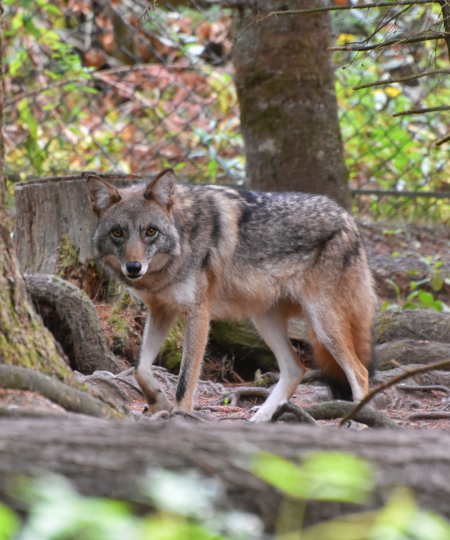
They have thick coats ranging in colour from greyish-brown to tan and bushy tails. They have pointed ears and their eyes are typically yellow or amber in colour. Females typically stand around 20-22inches at shoulder height, with a body length of 45-55 inches including the tail, and weigh 35-35lbs.Males are 22-24 inches tall, with a body length of 50-60inches, and weigh 40-50lbs on average.Eastern Coyotes are medium-sized canids with long legs, bushy tails, and large, pointed ears. Their coats are typically a mix of grey, brown, black, and reddish hues, with pale underbellies and dark-tipped tails. They are noticeably larger than Western Coyotes, averaging 20–25 kg for males and 16–20 kg for females, though some individuals can weigh up to 35 kg. Their body length ranges from 1.2–1.5 m including the tail, and they stand 58–66 cm at the shoulder. Their larger size is due to hybridization with Eastern wolves and domestic dogs, giving them a more robust build and broader skull.
They are found throughout northeastern North America, from the eastern United States up through Ontario, Quebec, and the Maritimes. In Canada, they are found in Nova Scotia, Prince Edward Island, Newfoundland and Labrador, New Brunswick, Quebec, and Ontario. In Nova Scotia, they are widespread across the mainland and Cape Breton Island, and are especially common in forest edges, agricultural fields, and near human settlements. They thrive in mixed and deciduous forests, shrublands, and open areas, often using trails, powerline corridors, and roads as travel routes. Highly adaptable, they have expanded their range significantly over the past century and now occupy habitats previously dominated by Eastern Wolves or avoided by Western Coyotes.
They are opportunistic omnivores with a varied diet that shifts with seasonal availability. Their primary food sources include small mammals such as rabbits, voles, and squirrels, along with deer (mainly fawns or winter-killed individuals), birds, insects, berries, fruits, and carrion. In agricultural areas, they may prey on livestock or scavenge waste. In urban environments, they may consume garbage, compost, and pet food. Their adaptable diet allows them to exploit a wide range of food sources, making them successful in diverse ecosystems.
They are monogamous and mate for life. Breeding occurs once a year in late winter from January to March. After a gestation period of about 60–63 days, females give birth in April or May to litters of 4–7 pups, though litter size can range from 2–12 depending on environmental conditions. Pups are born blind and helpless in dens made in hollow logs, rock crevices, or abandoned burrows. Both parents participate in raising the pups, with the males often providing food. Pups begin emerging from the den at around 3–4 weeks and are weaned by 5–7 weeks. They typically disperse in late fall to find their own territories. They reach sexual maturity at about one year and can live 10–14 years in the wild, though many don’t survive past 5 years due to predation and human-related mortality. Eastern Coyotes can live up to 18–20 years in captivity.
Eastern Coyotes are highly intelligent and adaptable, which makes them successful in a wide range of environments from deep forests to suburban neighborhoods and intelligent enough to outsmart human traps. They have excellent hearing, vision, and especially olfaction, which they use for hunting, communication, and navigation. Their long legs and lean bodies allow for swift, agile movement. They can run up to 65 km/hour and leap over 4 m in a single bound. On average, adults travel 20 km/day and maintain home ranges of 17–19 km², though this can vary depending on food availability and habitat. Their thick fur provides insulation during Canadian winters, and their bushy tails help with balance and warmth. Socially, they are flexible, living solitary, in mated pairs, or small family groups depending on food availability. They communicate with yips, barks, and howls to maintain social bonds and defend territory. Eastern Coyotes are also capable of interbreeding with Eastern Wolves and domestic dogs, producing fertile hybrids known as "coywolves" and "coydogs," which have contributed to their genetic diversity and increased size and adaptability. Their resourcefulness and ability to exploit human-altered landscapes have helped them thrive despite human pressures and habitat changes.