Great Horned Owl
Scientific Classification
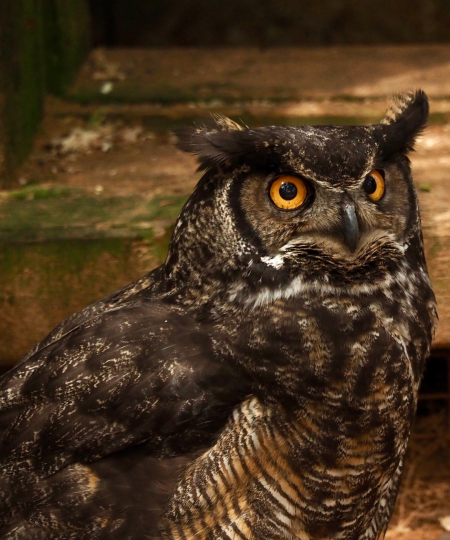
Great Horned Owls are large, powerful birds of prey with broad wings, short tails, and prominent feather tufts on their heads, commonly referred to as “horns”. Their plumage is mottled grey–brown with a white throat patch and barred underparts. They have large, forward-facing yellow eyes and a hooked black beak. Adults typically measure 45–63 cm in length with a wingspan of 1.0–1.5 m, and weigh between 0.91–2.5 kg, with females usually larger than males. Their powerful talons can exert a force of up to 3.4 MPa, allowing them to catch and kill prey much larger than themselves.
They are one of the most widely distributed owl species in North America and is found throughout Canada, including Nova Scotia. It inhabits a wide range of environments, from dense forests and wetlands to open fields, deserts, and city parks. In Nova Scotia, they are found in both rural and suburban areas, often nesting in wooded patches near open hunting grounds. They readily use abandoned nests built by other birds such as hawks, crows, or herons and may also nest in tree cavities, cliffs, or artificial structures. Their adaptability allows them to thrive in human-altered landscapes as well as natural ones.
They are carnivorous predators with a highly varied diet. Their primary prey includes small to medium-sized mammals such as rabbits, hares, voles, rats, and squirrels, but they also eat birds, amphibians, reptiles, and insects. They are one of the few predators that regularly hunt skunks, undeterred by the odor. They hunt mainly at night using exceptional eyesight and hearing, often swooping silently onto unsuspecting prey. Their strong digestive systems allow them to swallow prey whole and later regurgitate indigestible parts like bones and fur in the form of pellets.
They form long-term pair bonds and often remain together year-round. Courtship begins in late fall to early winter, with breeding typically occurring from January–March. Females lay 1–4 eggs in late winter, incubating them for about 30–35 days. Chicks hatch blind and helpless and are cared for by both parents. The female broods while the male hunts. The young begin to explore outside the nest at around 6 weeks and start flying at 9–10 weeks, though they may stay near the parents for several months. Sexual maturity is reached at 1–2 years. In the wild, Great Horned Owls live 10–15 years on average, but in captivity, they may live over 25 years.
Great Horned Owls have several adaptations that make them formidable nocturnal predators. Their large eyes provide excellent night vision, while their facial discs help funnel sound to their ears for pinpointing prey in complete darkness. They have asymmetrical ear placement to improve directional hearing. Their feathers are specially adapted to muffle sound, allowing them to fly silently. Strong talons and powerful leg muscles help them seize and kill prey instantly. Their camouflage plumage allows them to blend seamlessly into tree bark or foliage during the day. They are territorial and communicate through deep hooting calls that can carry over long distances, especially during breeding season.