Groundhog
Scientific Classification
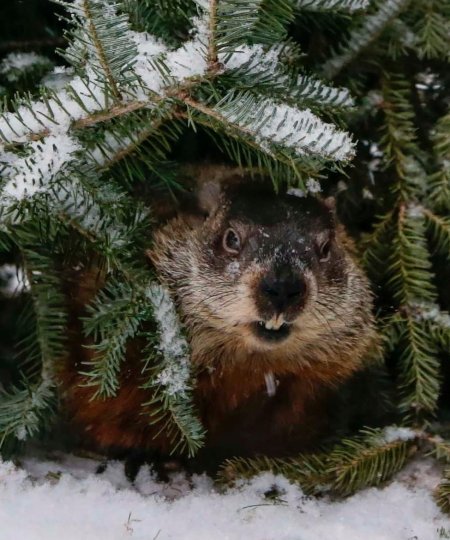
Groundhogs (also known as woodchucks) are short and stocky but often stand on their hind legs which makes them appear taller. Their colour varies from grey to dark brown, with light guard hairs giving them a grizzled appearance. Woodchucks can weigh 3-4 kg (6.6 to 8.8 lbs) and reach lengths of 42- 68 cm (16.5 to 26.8 in).
Groundhogs live in the eastern United States and throughout Canada. A familiar sight in fields, fence rows and rock piles, groundhogs are often seen sitting at the edge of their burrow.
As herbivores, groundhogs primarily eat green vegetation along with some berries, nuts, tubers, and the occasional insect. After they emerge from hibernation, groundhogs must rely on the bark and twigs from trees and shrubs, as grasses are not normally available so early in the spring.
One of only two true hibernators in Nova Scotia (little brown bats are the other), groundhogs prepare for hibernation by accumulating a large amount of body fat. In late September, groundhogs will confine themselves in a sleeping chamber in their underground burrow and not appear again until spring. Over several days, the groundhog’s body temperature drops with the ambient temperature of the burrow to about 3 degrees Celsius. Its heart rate drops from about 80 beats per minute to around 5. Metabolism is maintained by burning stored body fat at a slow rate, allowing the groundhog to emerge in the very early spring with a healthy layer of body fat, sustaining them until the grass has grown. Groundhogs mate after emerging from hibernation and young are typically born in May, in litters of 1 – 8, blind, hairless and helpless. Young groundhogs remain in the burrow for up to 6 weeks before venturing out to forage with their mother, quickly accumulating body fat and growing.
Groundhogs are excellent at digging, using their short, muscular forelegs and strong, curved claws to create underground burrows. These burrows feature sleeping, nesting, and nursery areas was well as several peep-holes and escape tunnels that allow the groundhog to stay aware of its surroundings while underground. Groundhogs are also seen sunning themselves on fallen logs or flat rocks on warm summer days.