Honey Bee
Scientific Classification
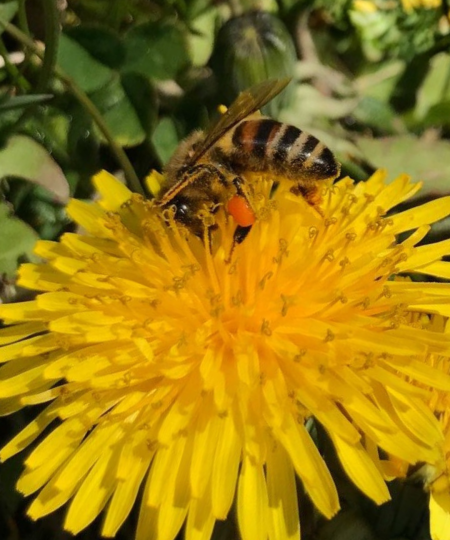
Honey Bees are insects, meaning they have an exoskeleton made of chitin, six legs and a body that is divided into three segments; the head, the thorax and the abdomen. There are several dozen different subspecies of Honey Bee, but the general appearance of a Honey Bee includes a generally reddish-brown body, two compound eyes and three simple eyes, a hairy head and thorax, black legs and an abdomen with alternting black and yellow bands. Honey Bees have a stinger at the end of their abdomen, which developed from a modified ovipositor. On their backmost legs are pollen baskets, which aids in the distribution of pollen as the bee moves from one flower to the next to collect nectar. Different subspecies can vary in their tongue length, wingspan and colouration, in additon to their responsiveness to threats and temperature tolerances. Honey Bees, being a eusocial animal, also differ between castes. Worker castes are 10 to 15mm (0.4 to 0.6 inches) in length, Queens are 18 to 20mm (0.7 to 0.8 inches) in length, and Male Drones are 15 to 17mm (0.6 to 0.7 inches) long.
Honey Bees are native to Europe, Africa and West Asia. Since the 17th century, they have been introduced to other parts of the world for the purpose of Apiculture; this includes the Americas, Australia and East Asia. In the wild, they are most accustomed to habitats with an abundance of flowering plants such as meadows, forests and human-made gardens. However, as long as there are sufficient resources and a hollow shelter for constructing a nest, Honey Bees can still survive in other ecosystems such as deserts and wetlands and grasslands.
Honey Bees primarily consume nectar and pollen, making them pollinators. Older Workers are responsible for the collection of nectar and pollen for the entire colony to feed on. The Older Workers will deliver the collected nectar and pollen to Younger Workers, who will then feed the other members of the hive. Any excess nectar will be converted into honey for long-term storage. Younger Workers will also secrete Royal Jelly from their salivary glands to feed bee larvae, with larvae developing into Queen Bees if they are fed only Royal Jelly.
Honey Bees are a type of Eusocial animal, meaning a large quantity of closely related individuals will work together and survive as a singular and cohesive unit known as a Colony. Eusocial animals are also notable for having different forms between individuals, known as 'Castes'. In the case of Honey Bees, they have three Castes: a reproductive Queen, sterile female Workers, and Male 'Drones' that will breed with a Queen. Individual Honey Bees have 4 life stages: Egg, Larva, Pupa and Adult. Drones will leave the hive a few days after emerging as an Adult and will congregate in areas near the hive known as 'Assembly Areas', waiting for new Queen Bees to stop by. Newly emerged Queens will spend their first few days taking trips out of their hive and scouting for good mating locations. A week in, she will take a couple of trips to any Assembly Areas that she discovered and will mate with any Drones within those Assemblies. The Drones will fly after the Queens and mate with her in mid-air. Once they complete mating, the Drone will drop away and die soon after, and any Drones that are unable to mate will die 4 to 8 weeks after forming an Assembly Area. A week after mating, the Queen will begin laying eggs, depositing them in Hexagonal Wax Cells either in the hive of her birth that she inherited from her mother, or with newly made cells constructed by any Workers that joined her in forming a new hive. The Queen will lay around 1000 eggs a day and can control as to whether or not the eggs that she lays will be fertilized; fertilized eggs will be female, becoming either a Worker or a Queen later on, and any eggs that she lays that are not fertilized will become Male Drones. 1 to 6 days later, a Larva will emerge from the egg and stay in the wax cell that it was placed in. For the next 4 to 7 days, the Larvae will be fed by Younger Worker Bees, receiving a combination of Pollen, Nectar, Honey and Jelly. If a female Larvae is fed only Royal Jelly, they will eventually develop as a Queen, otherwise they will develop into a Worker Bee. Once sufficiently fed, Worker Bees will seal the cell, and the Larva will metamorphose into a Pupa with a silk cacoon. The length of time that a bee will stay in its Pupal stage depends on what caste it will become as an Adult; Drones require about 2 weeks to pupate, Workers need 12 days and a Queen will emerge after about a week. Worker Bees perform different tasks depending on their age since emerging from their Pupal form. Newly emerged Workers will focus on cleaning and preparing wax cells for either new eggs or for Honey storage. Younger Workers will also focus on removing waste material from the hive, regulating the hive's temperature and airation by fanning their wings, and feeding the Queen and Larvae. Once the Wax Glands on a Worker Bee develops a week later, their tasks change to wax cell production, as well as hive repair and maintenance, though they will still aid in feeding the Queen and their Larvae. After the second week, Workers will shift their focus to guarding the hive, inspecting any foragers that return with food and ward off any threats to the hive. At the three week mark, the Workers will spend their final week of life on foraging duties during the daylight hours, usually collecting food within 3 km of the nest. Most Workers will perish after the four-week mark, but those that live in colder climates can go dormant and over-winter with their Queen, allowing for them to bring the hive back into normal operation once spring returns. Queens can live for 2 to 5 years. If a Honey Bee Colony reaches a large enough size, a new Queen is produced, and the Mother will take half of the Workers to a nearby location and construct a new hive, while the new Queen inherits the old hive. If more than one Queen emerges, they will fight to the death until only one Queen remains. However, if the colony size is still large enough, even after the Mother Queen leaves with half of the Workers, the first few Queens that emerge from their Pupae will leave with a number of Workers to form their own colony.
The most apparent adaptation of Honey Bees is their Eusocial lifestyle, which results in the division of tasks between different specialized individuals. Drones and Queens focus on the reproduction of more Bees, while the Worker caste focuses on the provision of resources and ensuring the survival of the colony. With the Workers focusing on keeping the Queen fed, she does not have to expend energy foraging for her own food and can instead focus on producing as many eggs as possible. Workers also perform different tasks depending ontheir age, with Younger Workers staying within the nest and focusing on mainteneance, while Older Workers venture out of the hive and forage for food. Keeping the Younger Workers safe inthe hive means less time lost from a potential senario where a young Worker dies before reaching old age, meaning the Colony is making the most efficient use of the time a Worker is alive for. Aside from their caste system, Honey Bees have an assortment of other adaptations that allows for them to best contribute to the survival of the Colony. For starters, Honey Bees can see Ultraviolet Light; this allows for them to see daylight during overcast weather, and allows for them to spot patterns on flowers that are only visible under UV Light. When it comes to communicating with other members of the hive, Honey Bees use both chemical pheromones and the emmission and detection of vibrations. Each colony has their own chemical signature, which allows for them to identify other members of the colony and to weed out intruder bees from other colonies. In terms of vibration detection, Forager Worker Bees can relay information on good foraging locations to other Workers using specialized dances. For good foraging sites that are within 100 to 300 meters, Workers will use a Circular Dance, which does not communicate exact direction or distance, but the level of enthusiasm displayed in the dance determines the quality of the foraging site, and by extension determines how many other Workers are recruited by the dance in order to locate the foraging site. For longer distances, a Worker Bee will use a Waggle Dance, with the number of circuits completed in a fixed span of time indicating the distance to the foraging site, and the angle that the Worker is positioned in during the straight-portion of its circuit determining the direction of the food source. The Worker can calculate the direction it needs to travel based on the position of the sun, which is why Honey Bees only forage during the daytime. When defending their hive, Worker Bees will use a venomous stinger on the end of their abdomen to sting the threat. Because the stinger is barbed, the stinger and the attached venom glands are ripped out the abdomen after the Worker stings its target. While this unfortunately leads to the death of that Worker, their act of stinging also emits an Alarm Pheromone, which signals more workers to assail the threat. Being able to fend off predators are important as there are many different species of animals that will attack either individual bees or their colonies, as their hives are very resource rich. Animals that directly predate on Bees include Spiders, Wasps, Wax Moth larvae, Ants, Beetles, small Mammals, Frogs and Birds, some of which are specialists in hunting bees. Animals that will attack entire colonies in their native range include Bears, Honey Badgers, Apes and Pangolins, while Honey Bees in introduced areas must contend with smaller Mustelids, Skunks, Armadillos and Anteaters.