Indian Peafowl
Scientific Classification
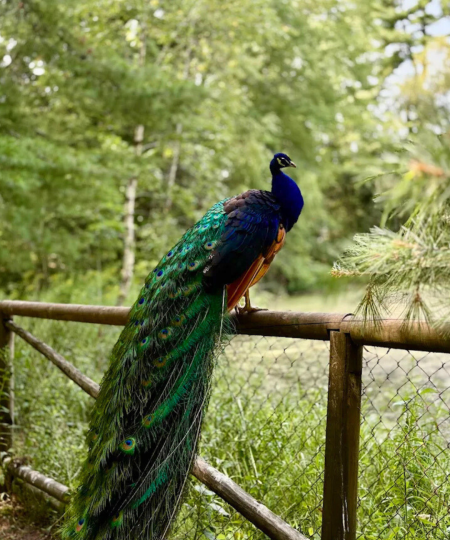
Indian Peafowl are large, ground-dwelling birds known for their spectacular plumage. Male peacocks are bright blue with shimmering green and gold highlights, a crested head, and an iridescent train of elongated upper tail feathers that reach up to 1.5 m long and contains 200 feathers with distinctive eye patterns that can fan out during courtship. Peahens are more muted, with brown and green plumage and shorter tails. Peacocks measure 2.0–2.3 m in length including the train, while female peahens are around 0.8–1 m long. They typically weigh 4–6 kg, and both sexes have strong legs and spurs for defense.
They are native to India, Sri Lanka, and parts of Southeast Asia, where they inhabit open forest, farmland, and scrubland. They have been introduced to many countries as ornamental birds, and are common in captivity across Canada. In Nova Scotia, they are not found in the wild, but are kept at wildlife parks, petting zoos, private estates, and hobby farms, often in free-ranging enclosures or large outdoor pens. They require shelter during the winter and are often brought indoors or into heated barns when temperatures drop below freezing.
They are omnivorous foragers. In the wild and in captivity, they eat grains, seeds, fruit, insects, small reptiles, and even small mammals. They forage primarily on the ground but may roost and perch in trees. In Canadian facilities, they are typically fed poultry pellets or game bird feed, supplemented with fresh greens, grains, and protein sources like mealworms or insects.
During the spring and summer breeding season, peacocks perform elaborate courtship displays, fanning their trains, shaking them to produce a rustling sound, and emitting loud calls. Peahens select mates based on train size, pattern, and behavior. Peahens lay 4–8 eggs in shallow ground nests, which they incubate alone for 27–30 days. Chicks are precocial and follow the mother shortly after hatching. Peafowl reach sexual maturity at 2–3 years, and peacocks typically begin displaying their trains at age 3. After the breeding season, peacocks shed their trains in late summer or early fall and regrow them by the next spring. Juvenile peacocks resemble peahens and don’t develop their trains until about 2–3 years old. This helps them avoid aggression from adult males and predators during early development. In the wild, Indian Peafowl live 10–15 years, while in captivity, they often live 15–20 years or more.
Indian Peafowl are well adapted to ground-foraging and predator avoidance. Their large, strong legs allow them to run quickly. Despite their size, they are strong fliers over short distances, and will jump up into trees to roost together overnight. Their strong legs and wings give them impressive launch power allowing them to leap 2–3 m vertically from a standing position to reach a roosting branch or fence top. Their loud alarm calls alert others to danger, and their cryptic colouration, especially in peahens and juveniles, offers camouflage protection in dense vegetation. Peacocks use their ornamental trains in visual and auditory courtship, a key example of sexual selection. During courtship peacocks can shake their train at speed so fast that it creates a low-frequency sound that peahens can feel rather than hear. This vibration enhances the visual display and may influence mate choice. They have excellent colour vision and can perceive UV light, which plays a role in how their feathers shimmer and how they recognize each other. They have iridescent feathers but no pigments. The vibrant blues and greens of peacock feathers are due to microscopic structures that reflect light, not actual pigments. This phenomenon is known as structural colouration, like butterfly wings or hummingbird colouration. In Canada, are cold-tolerant if given dry shelter and proper care, and many have adapted well to life in managed outdoor enclosures, even in winter.