Patagonian Mara
Scientific Classification
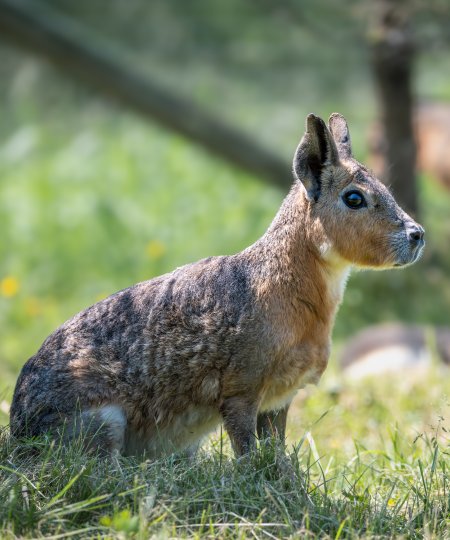
The second largest living member of the Caviidae Family after the Capybara, they can weigh anywheres between 8 to 16kg (18 to 32lbs) and have a length ranging from 61 to 81 71cm (28 inches), with males usually being larger than females. Unlike the other members of its Family, it has long ears and a nearly hairless short tail tucked close to its body. The top side of its body is covered in short grey fur that transitions into a darker grey near the rear end, only to abruptly transition into a white patch on the rump. The underside of the body is white, with a iron-rusty colour on its cheeks, chin and sides of its body. Most noticeable with the Maras are its elongated legs and small, hoof-like feet, allowing for it to run at fast speeds. The feet on their forelegs have 4 digits while their hindquarters have 3 digits.
Patagonian Maras are found in the Patagonian region of Argentina. The habitats that they prefer tend to be arid and semi-arid in nature, hosting an array of microclimates such as shrubland steppes, grasslands and sandy plains. This region of habitation often hovers around 20ºC during the Austral summer months, and does not drop below freezing during winter.
The majority of the Mara's diet consists of grasses, specifically only the topmost portion. Different species of grasses are consumed depending on the latitudinal location of the Mara. Maras do consume other plant material as well; those that live in the more southern, arid portion of its range will consume cacti, likely also acting as a source of water to counter the region's varied precipitation rates. Those that liver further north towards and in the Pampas grasslands will also consume plant material from the shrubs of both the Nightshade and Pea families. They will also take advantage of the post-rainy season by consuming herbs, while switching to more moisture-righ plants such as fruits and the previously mentioned cacti during droughts. They have a symbiosis with bacteria in their hindgut that aid in fermentating and breaking down plant fibres and cellulose. In order to extract as much food as possible from the plant material that they ate, they will consume their own feces and redigest it.
Maras are monogamous, with the mating pair forming a bond that lasts their entire lives. Males will viciously protect the female from other male Maras; as a result, Maras will spend most of their time as a solo traveling pair with a mobile territory, only forming groups of multiple monogamous pairs during pup-rearing. Female Maras will undergo Estrus every 3 to 4 months, lasting only for half an hour. After a gestation period of about three months, the female Mara will give birth to a litter of 1 to 3 pups anywhere between late August and December, with the majority of births occuring during the early Argentinian spring from September to October. The pups are born precocial, meaning they are readily able to move around once they are born. The newborn pups will be nursed for the next two and a half months. For the first three weeks, the pups will utilize a hiding behaviour not unlike deer fawn to stay safe, but will transition afterwards into a following behaviour, trailing close to their mother while she grazes. During this nursing period, parent Maras will form small groups and utilize a communal warren for rearing their pups, with each pair taking a turn to use the den for nursing. While the female Mara focuses on nursing the pups and grazing, the male Mara focuses on keeping a look out for potential predators, alerting his mate and offspring if a threat is detected. Predatory animals that Maras look out for include Foxes, Pumas, Hawks and a species of South American Mustelid known as the Lesser Grison. Once the pups are weaned, they will begin to venture off on their own, though a small percentage will stay with their mother until the next breeding season. Maras become sexually mature by 8 months, and have a lifespan of 7 to 10 years in the wild.
Maras are built to survive in the open arid environment. Their larger ears contributed both to predator detection and to aid in expelling body heat, allowing for them to keep cool during warmer seasons. Their long legs aid in their ability to run at high speeds, reaching up to 72 km/h (45mph). Their feet and claws have also developed to be hoof-like in nature, further aiding in their ability to run. Behaviour-wise, Maras will use their acute sight, hearing and smell to scan their surroundings for potential predators, providing them with ample time to flee once a threat is spotted. Many of the Mara's adaptations share superficial similarities to that of ungulates such as antelope and deer. This is a brilliant example of Convergent Evolution, a concept in Evolutionary Biology where two different lineages of organisms develop a similar body plan or set of adaptations that allow for them to survive in their environment. In this case, the Mara developed the same adaptations as ungulates for fast movement in open terrain, as there are a lack of ungulates in the Patagonian Steppe to fill in that niche. Because of the sparse and irregular distribution of plant material in their environment, Mara pairs are described as having a mobile territory, changing locations as they deplete the available food in a given area. While traveling, male Maras will use their anal glands to mark their scent by dragging their rear-end across the ground, marking the territory currently occupied by its mate. Maras are awake during the daytime hours to feed.