Peregrine Falcon
Scientific Classification
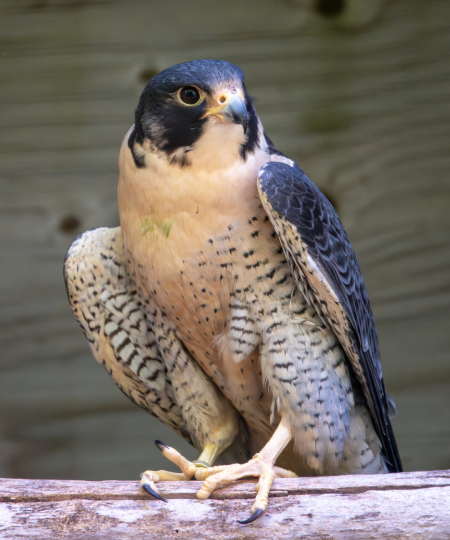
Peregrine Falcons are medium-sized raptors with long, pointed wings and a narrow, tapered tails. Adults have bluish-grey upperparts, a pale chest with dark horizontal barring, and a distinctive dark moustache mark below the eyes. Their legs and feet are yellow, and their eyes are dark and intense. Males are typically smaller than females, weighing 500–750 g, while females can weigh up to 1,200 g. Wingspans range from 90–120 cm. Their aerodynamic build and powerful muscles allow them to reach incredible speeds during hunting dives known as stoops, making them the fastest bird in the world.
They are found on every continent except Antarctica. In Canada, they are distributed across all provinces and territories, including Nova Scotia, where they were once locally extinct but have successfully re-established populations along the Bay of Fundy. In Nova Scotia, they nest on remote coastal cliffs, rocky outcrops, and occasionally urban buildings and bridges. Peregrines prefer open landscapes near water, including coastlines, river valleys, and tundra. Their nesting sites, known as eyries, are usually high and inaccessible, providing safety from predators and a wide view of surrounding territory.
They are specialized bird hunters, preying mostly on medium-sized birds caught in mid-air. Their diet includes pigeons, shorebirds, ducks, songbirds, and seabirds. Peregrines hunt by soaring or perching at high vantage points, then launching into a high-speed dive to strike prey with their talons. They kill with impact and rarely consume carrion. In coastal areas like Nova Scotia, they often feed on seabirds such as gulls or puffins. In cities, feral pigeons are a common food source. Their hunting style relies on exceptional eyesight and incredible speed to catch fast-moving prey.
They are monogamous and typically form long-term pair bonds. They are highly territorial and may return to the same nest site year after year, even decades later. Breeding begins in early spring, with courtship displays involving aerial acrobatics and mutual calls. Females lay 2–5 eggs, usually in April or May, in a shallow nest scrape on a ledge or cliff. Eggs are incubated for 29–32 days, primarily by the females, while the males provide food. Chicks hatch covered in white down and grow rapidly, fledging at 5–6 weeks old. They remain dependent on their parents for several more weeks while learning to hunt. Peregrines reach sexual maturity at about two years old. In the wild, they typically live up to 12–15 years, though many don’t survive past their first year.
Peregrines are built for speed, with long, pointed wings, powerful breast muscles, and streamlined bodies. Their nostrils have bony tubercles that slow airflow during high-speed dives, preventing lung damage. They have excellent vision that is estimated to be 8 times better than humans, allowing them to spot prey from great distances. Their sharp talons and beaks are designed for catching and killing birds mid-air. Peregrines also have a unique toothlike structure on their upper beak, known as a tomial tooth, to allow for a quick and efficient kill of their prey. Their nesting behaviour includes choosing inaccessible ledges or tall structures to help protect their young from predators. Their ability to adapt to urban environments, including nesting on skyscrapers and hunting pigeons, has aided their recovery in areas like Nova Scotia. The return of the Peregrine Falcon is considered one of Canada's greatest conservation success stories.