Porcupine
Scientific Classification
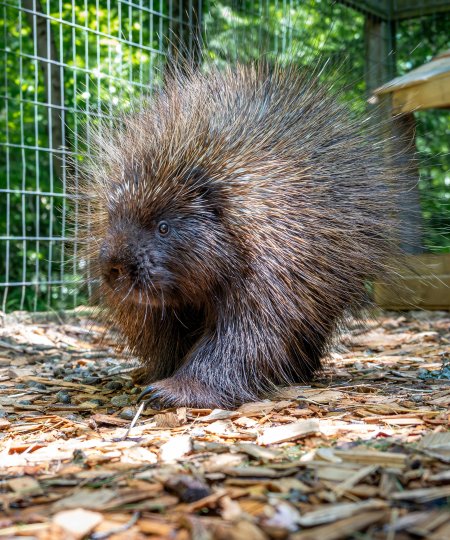
Porcupines are larger than their weight might suggest, reaching up to 1 m (3.3 ft) in length while weighing only 10 kg (22 lb). Second in size to the beaver, they are unlike any other North American rodent due to the sharp, keratinous quills covering their neck, back, sides, and tail. These barbed quills range in length from less than 1 cm (0.5 in) to about 7.5 cm (3 in), with the longest ones found along the lower back and tail. When threatened, porcupines can raise many of their 30,000 quills by contracting tiny muscles in their skin. Contrary to popular belief, porcupines cannot shoot their quills and the quills only detach through contact. On the ground, porcupines are clumsy due to their large bodies and short legs. In trees, however, they are agile, albeit slow and deliberate, using their long claws to help them climb. Their coats are typically dark brown, while the quills have paler tips.
Porcupines are commonly found in coniferous and mixed forest areas across North America, with the exception of island forests. Like many animals, they have adapted to the presence of humans and can be found denning under cottages or eating garden shrubs and other cultivated plants.
As herbivores, porcupines prefer buds, needles, small twigs, and the inner bark (cambium) of various coniferous trees, though they can also be found grazing on shrubs and other plants. Like other rodents, they need to chew on tough materials to prevent their constantly growing front incisors from becoming too long, which would impede their ability to eat.
Although primarily solitary, porcupines may den together in large groups during the winter. Interaction is minimal, even during the mating season in autumn. Female porcupines give birth to a single young after a 7-month gestation period. Porcupines are born with a full coat of hair, including short, soft quills, with their eyes open and teeth already emerged. Growth is rapid; weaning occurs after only a few weeks, and young disperse from their mothers by fall and are fully mature and ready to mate at 2 years of age.
While the porcupine’s quills are its most obvious survival adaptation, this barbed, regenerating defense is not their only interesting trait. The first digit on their hind foot is uniquely shaped and padded, allowing a firm grip while climbing. Additionally, porcupine skin contains an antibiotic-type substance that prevents infection if they impale themselves with their own quills or those of another porcupine.