Reeves's Pheasant
Scientific Classification
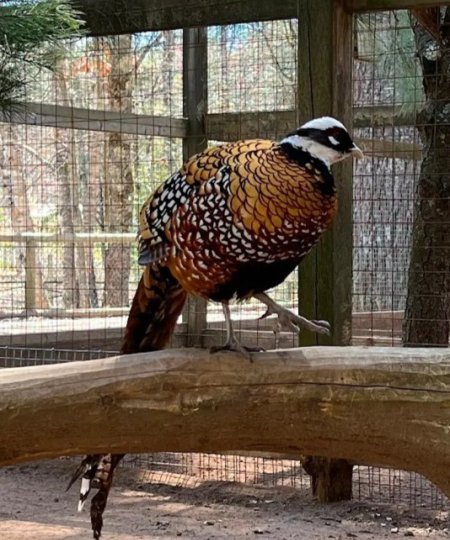
With this ornamental pheasant, males (cock) measure 210 cm (83 in) long and weigh 1,529 g (3.371 lb). The male is brightly plumaged with a scaled golden white and red body feathers, grey legs, brown iris and bare red skin around the eye. The head is white with a black narrow band across its eyes. The male has an extremely long silvery white tail barred with chestnut brown. Females are smaller than males, mottled and less flashy, being a lot paler than males. Females have a cream-colored head with a brown cap and masking around the face and eyes.
Endemic to China, this pheasant prefers evergreen forests but may utilize open woodland. Females choose higher ground for nesting. The Reeves's Pheasant tolerates both hot and cold temperatures. They are non-migratory but were introduced to the UK, France and the Czech Republic.
Seeds, berries and leaves but as omnivores, also consumes worms, insects and other small invertebrates. They forage on the ground in groups of about ten, using their strong legs to scratch away leaf litter and find food.
The breeding season for Reeves's Pheasants lasts from April to June. Males establish territories and perform elaborate courtship displays to attract females, often involving wing-flapping and tail-flapping. Females construct nests on the ground, usually hidden in dense vegetation. The nest is a shallow scrape lined with leaves and grass. A clutch typically consists of 7-14 eggs, pale buff with fine brown speckles. Incubation lasts about 24-25 days, carried out solely by the female. Checks are precocial and can leave the nest shortly after hatching but remain with the mother for several weeks as they learn to forage. These pheasants live to be about 9 years of age.
Strong legs for running up to 40kmh. Short, fat wings for quick bursts of flight to escape predation even in the undergrowth where they forage. Their agility combined with their skittish behaviour helps them detect and escape predation.