River Otter
Mi'kmaq Name: Kiwnik (pronounced gew-nick)
Scientific Classification
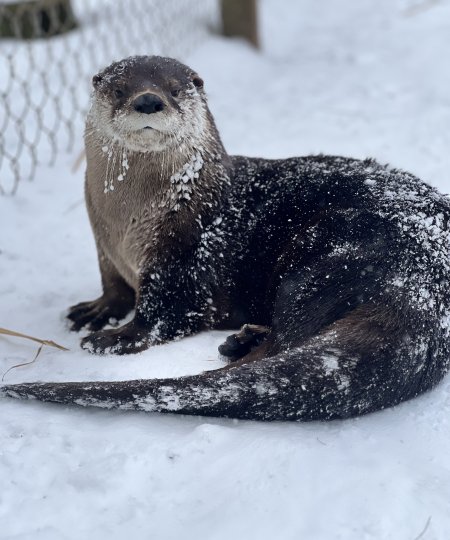
Being a member of the Weasel Family (Mustelidae), River Otters possess the signature elongate body with stout legs, but also have a broad tail that tapers towards the tip. Their coat is mostly brown with a lighter silvery-greyish underside, throat, chin and snout. Otters are around 90 to 120 cm (3 to 4 feet) long from snout to tip of the tail and an average weight of 5 to 14 kg (11 to 30 lbs) with males usually being larger than females. They have small eyes, and small rounded ears, with long whiskers on their cheeks.
River Otters can be found throughout the North American continent, from as far north as the Yukon and Northwest Territories to as far south as Mexico's Rio Grande and Colorado river deltas. In Canada, they can be found in every province and territory, though they have only returned to PEI during the early 1900's after being extripated from that province. As an aquatic mammal, Otters are often found in habitats with a sufficient amount of water; this can include wetlands (marshes, swamps, bogs, etc.), river networks, lakes, and coastal estuary systems. Otters will avoid any water systems that are exposed to heavy pollution mainly them an indicator of a healthy ecosystem.
River Otters are carnivores, consuming a vast array of animals including fish, crustaceans, mulloscs, frogs, reptiles and birds, including their eggs. On rare occasions, Otters will take down mammalian prey or consume plant material.
River Otters reach sexual maturity between 2 to 3 years of age and will breed during the late winter months into the early spring season, after which the male will leave the female to birth and raise the pups on her own. While the gestation period is only two months, female otters will employ a process called delayed implantation, rendering the fertilized embryo dormant for up to a year. From there, the female will give birth to an average of 2 to 3 pups between the months of November to May, but can birth as few as a single pup and as many as six. The pups are born blind and shelter in their mother's den for the first month of their lives. After two months, their mother teaches them how to swim. The pups are weaned off of their mother's milk at three months and will begin to venture off on their own by six months to a year in age. The lifespan of an otter in the wild is usually 8 to 9 years, but those in captivity can live for up to 21 years. Otters will utilize natural hollows or abandoned dens near river banks as a means of shelter and will ensure that the den has an underwater entrance. The most common predators of Otters are cobcats and canines such as coyotes and wolves. Larger bird of prey species can also hunt down Otters and alligators can predate Otters in their more southern range.
As aquatic mammals, they have a thick, waterproof coat for insulation while in the water as well as for winter conditions, and they have webbed feet allowing for efficient swimming. They can close their nostrils and ears while submerged, and also possess a clear third eyelid known as a nictitating membrane, which protects their eyesight while diving and swimming. They sport a long set of whiskers (vibrissae) that aid in detecting prey hidden in the substate of the water bodies that they swim in. Otters have multiple methods of communication, including audible methods (whistling, growls and screams), scent marking with their scent glands and visual/tactile methods such as touching and body posturing. Otters posses an extremely high metabolism, and as a result requires a constant supply of food to hunt and forage for.
In Mi'kmaq culture, the Otter is valued for its waterproof fur used to make clothing, particularly mittens. Their meat was eaten, and its bones and teeth were made into tools and ornaments. The Otter represents playfulness and their curious spirit teaches joy and living in balance with land and water.
Otters can hold their breath for up to 8 minutes and can close both their nostrils and their ears to aid in their prolonged dives.
Otters do not hibernate; they still swim under the ice during the winter, using breaks in the ice as breathing holes.
Otters have a set of scent glands near the base of their tail that emit a strong, musky odour, which they use to mark their scent on their territory.
Much like children, Otters are frequently observed playing with one another, with activities such as sliding, swimming and burrowing in the snow. This play allows Otters to acquire skills that can aid it in hunting and general survival. During winter, Otters slide on their stomachs along ice and snow for fun and as a more efficient means of movement.
The Otter's dense pelt made them highly sought after by fur trappers and hunters, resulting in a significant decline in population during the late 1800's and early 1900's. Thankfully, extensive conservation and reintroduction measures have allowed for River Otter populations to recover to stable levels, including the return of Otters to PEI where they had been extirpated (locally extinct).