Wild Turkey
Scientific Classification
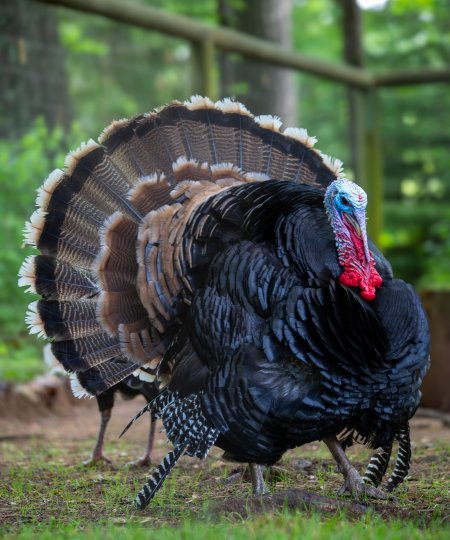
Wild Turkeys are large, ground-dwelling birds with broad, fan-shaped tails, long legs, and bare, reddish-blue heads. Their body feathers are dark brown with an iridescent bronze or greenish sheen. Males are larger than females and have prominent wattles, and snoods which are fleshy growths over the beak, and a beard of coarse hair-like feathers on their chest. Adult males typically weigh 7–10 kg and measure 100–125 cm in length, while females are smaller, weighing 3–5 kg. Despite their size, they are agile runners and strong short-distance fliers.
They are native to North America, originally ranging from Mexico through the eastern and southern United States. In Canada, they were historically present in many provinces but were extirpated by overhunting and habitat loss. Reintroduction programs beginning in the 1980s have successfully established populations in Ontario, Quebec, Manitoba, British Columbia. While they have not lived in Nova Scotia, introduction of the species as a game bird has been considered in the past.
They are omnivorous foragers, feeding primarily on plant matter such as acorns, seeds, nuts, grasses, berries, and leaves. They also consume insects, snails, small amphibians, and even the occasional small reptile or rodent. Turkeys forage by scratching the ground with their feet or probing leaf litter with their beaks. Their diet varies seasonally, with a focus on high-energy foods like acorns and beechnuts in the fall and protein-rich insects in the spring and summer.
They breed in early spring, with males displaying by gobbling, strutting, and fanning their tail feathers to attract females. After mating, females lay 10–14 eggs in shallow nests hidden in vegetation. Incubation lasts about 28 days, and young turkeys known as poults hatch fully feathered and mobile. They can fly within 1–2 weeks and stay with their mothers through summer. Sexual maturity is typically reached at 1 year. In the wild, they live 3–5 years on average, though they can live up to 10 years. In captivity, with protection from predators and disease, they may live up to 10 years. The oldest known wild turkey lived to at least 12.5 years old.
Wild Turkeys are well adapted for life on the ground and in mixed forest habitats. Their long legs make them fast runners reaching speeds up to 40 km/hour. Their strong wings allow for quick bursts of flight to escape danger, allowing them to fly short distances at speeds up to 88 km/h, despite their large size. They have excellent eyesight that allows them see in colour and have near–360° vision. Their eyes are on the sides of their head, giving them an almost panoramic field of view, and they can detect even slight movements from far away. Keen vision and hearing help detect predators, and their cryptic plumage blends in well with forest undergrowth. Males use vocalizations, posture, and plumage displays to establish dominance and attract mates. Despite being large, ground-dwelling birds, wild turkeys fly up into trees together at night to roost safely away from predators.