Eastern Painted Turtles
Mi'kmaq Name: Mikjikj (pronounced mick-jick-ch)
Scientific Classification
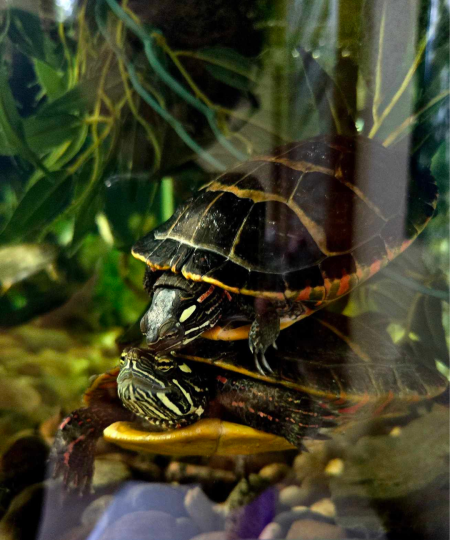
This is the most common and most colourful turtle in Nova Scotia. The carapace (top part of the shell) is smooth and gently rounded. It is dark green to black with yellow and red markings along the sides and around the edges of the shell plates. The plastron (underside of the shell) is tan to yellow, and typically unmarked, but may have small dark blotches in the center. The head and legs are black to green with red and yellow streaks. The neck, legs and tail are streaked with red.
In Canada, Painted Turtles have the widest range of any freshwater turtle species, occurring from British Columbia to Nova Scotia. In Nova Scotia, painted turtles are common in the Southwestern region of the province, becoming less common or absent in the Northeast. There are no kmown records from Cape Breton.
Painted turtles are omnivores. They eat a variety of aquatic insects and their larvae, invertebrates (particularly snails), carrion, and small vertebrates like fish and frogs. Small pieces of lily pads and other plant materials also make up part of their diet.
Painted turtles are active from April until early October, and nesting occurs from late May until early July. Nests are dug along roadsides or in cultivated fields, in sand or gravel beaches, forest clearings, meadows and fields. Ideal sites are found in habitats with high sun exposure and within 200 meters (656 feet) of a water body. The number of eggs a female can lay will depend on her age, size, and how many clutches – or groups, she has already laid. Up to 11 eggs can be laid in a nest and females can have several clutches per year. Hatchlings typically emerge in late September to the end of October; some may overwinter in the nest and emerge the following spring. The egg’s temperature during development determines the gender of the hatchling. Warmer temperatures produce female turtles and cooler temperatures produce males. Females reach sexual maturity around 12 to 15 years of age and have a life span of approximately 50 years or more.
To survive winter, Painted Turtles have an antifreeze-like substance in its blood that prevents freezing, allowing it to survive under the ice while brumating. Brumation is similar to hibernation but unique to reptiles where they conserve energy by slowing their metabolism and reduce their need for oxygen. As a cold-blooded animal Painted Turtles bask in the sun to warm up. While basking they also remove leeches they've picked up while swimming.
In Mi'kmaq culture, the Turtle is used in ceremony with their shells being made into rattles. Turtles are used to teach Truth and are connected with Creation stories. The 13 plates on their shell represent the 13 moons of the year and symbolize a connection between natural cycles and the balance of life on Turtle Island (North America).
The earliest evidence of painted turtles dates back 15 million years when remains of this species were discovered.
During the last glacial period, there was the evolution of three distinct subspecies. Eastern, Midwestern and Western subspecies have all been identified thus far. Sometimes a fourth subspecies is recognized as the Southern Painted Turtle.
Painted Turtles are a social species, with over 50 individuals observed to be basking on one log!
They can learn simple tasks like swimming to a specific area or recognizing food sources. Turtles also use memory to help them navigate their habitats. Some have been observed returning to the same basking spot each day. These behaviors suggest a higher level of learning than many might expect.
Painted turtles males track down females when the water gets warm enough then make a courting gesture by tapping her on the face which she returns if receptive. They can be aggressively territorial particularly when persuing females.