Giant African Land Snail
Scientific Classification
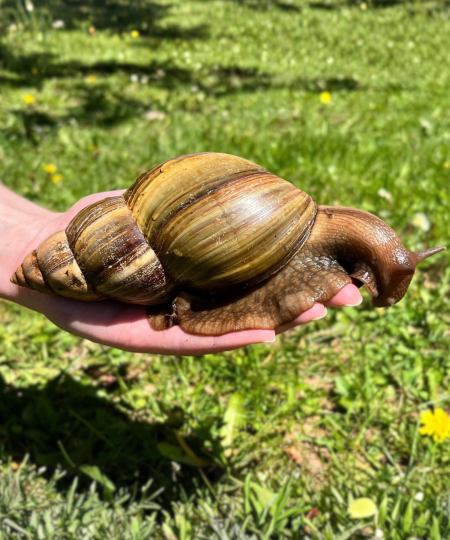
The Giant African Snail has a body length of up to 8 inches, and can reach between 2 and 4 inches high. When fully grown, they are around the size of an adult human fist. Their large shell covers at least half of their body length. Ranging from a light tan to a dark brown, the shells consist of between 7 and 9 full whorls, with the body whorl being by far the largest, although it has a relatively narrow opening. The shells may also have reddish tints, or yellow streaks.
Native to Eastern Africa including Kenya, Somalia and Mozambique. However, due in part to trade as pets and accidentally disbursement, they are now found on every continent except Antarctica. The inhabit the outskirts of forest, or the edges of rivers, streams and other wetlands, but have adapted to other environments including urban areas
Leaves, flowers, vines, fruits, seeds, bark and moss
Although the Giant African Snail is a hermaphrodite, meaning that they have both male and female reproductive organs, they do not seem to self-fertilize. Around 8-20 days after mating, the snail will lay between 100 and 500 eggs in the ground, usually in a nest or underneath rocks or plant matter. The eggs hatch after around 2 weeks and are left to fend for themselves immediately, with no care from the parent snail. However, the hatch success rate is still up at around 90%, so the numbers of this pest can rise very rapidly under the right conditions. Each snail will generate around 5 clutches of eggs per year. During the mating process, each snail will produce sperm and fertilize the eggs of the other. The eggs of Lissachatina fulica are pure white and opaque but may be slightly yellowish or even somewhat transparent. The eggs have a thin, calcareous shell, and are about 5 mm long and 4 mm wide.
The creatures have the capacity to withstand hot, drought-like conditions by retreating into a state of dormancy within their shells. Their bodies can produce a layer of mucus to help keep the snail moist until conditions become more favourable. During the cold months, they will again retreat into their shells and limit all activity such as moving or eating to conserve energy. They do this by slowing down their metabolism. They can hibernate for up to 3 months.