Mallard Duck
Mi'kmaq Name: Apji'jgmuj (pronounced app-jeeg-ka-much)
Scientific Classification
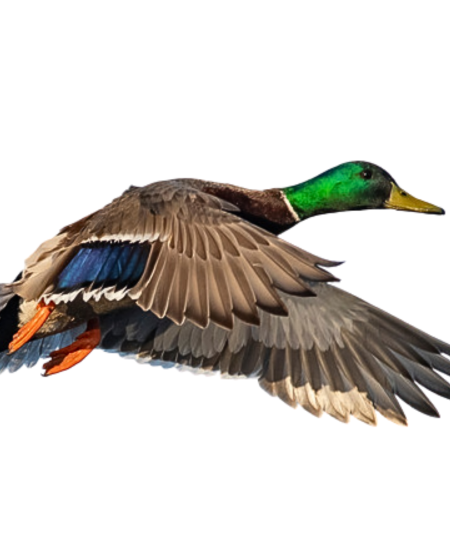
Mallards are typically thought to look very different between males and females. Males display a bright green head, yellow bill, white neck ring, and a gray body with a brown breast, while females appear drabber with mottled brown feathers and an orange bill with black splotches. These bright colours are only to attract a mate, however, as outside the breeding season males appear similar to females to blend in with their surroundings. Both sexes share a patch of iridescent blue feathers on their wings, which distinguishes them from hybrid mallard species. Males and females are about the same size, typically measuring 50 to 65cm (20-26 in) in length, with wingspans of 82 to 95cm (32-38 in).
While the Mallard Duck’s distribution reaches across North America and Eurasia, in Canada they are most abundant in southern regions (such as Nova Scotia) during the summer breeding season. Whether a Mallard overwinters or migrates south depends on environmental factors such as the presence of open water and availability of food sources. Consequently, feeding ducks can delay migration by providing an artificial food source, which can encourage them to stay in conditions that become too harsh for survival. Mallard Duck's primary habitat is nearly any type of wetland, including those with fresh or brackish waters, and they can also be seen in forests, farmland, and urban areas.
Mallards are an adaptable species as they can feed both on land and in water. Being classified as dabbling ducks, they forage in shallow water instead of diving. They are opportunistic, eating whatever is most available at the time. As a result, they consume more animal matter in the spring/summer (aquatic insect larvae, crustaceans, tadpoles, etc.), and more plant matter in the winter (sedges, grasses, pondweed, etc.).
In Spring, before laying eggs, the mating pair of Mallard Ducks will search together for a suitable nesting site: dry upland near a body of water. Once laid, the clutch (usually 1–13 eggs) is incubated by the female for about a month, during which time the male will leave. Ducklings emerge covered with down feathers and are highly capable - in fact, they can begin to leave the nest just 13 to 16 hours after hatching. Mallard Ducks become fully independent from their mother at about 8 weeks old and typically live for about 5 to 10 years in the wild.
As Mallard Ducks live both on land and in water, their bodies are adapted to both environments. For example, their legs are positioned near the center of the body rather than the back (as with sea ducks), limiting their swimming speed but granting better balance on land. The comb-like structure found inside all waterfowl bills, called lamellae, is closely spaced to better filter food from the water.
In Mi'kmaq culture, Ducks are an important food source for meat and their feathers were used in clothing, art and for bedding. Harvesting ducks reflects a deep knowledge of wetlands, seasons and animal behaviour. It teaches respect, patience, skill and only taking what is needed.
Even if mallard eggs are laid on separate days, they will all hatch at relatively the same time.
Only female mallards quack! Males make a quieter, raspy, gargling sound.
Mallards often breed with other duck species, producing hybrid offspring that can be hard to visually distinguish.
The green head of the male mallard, called a drake, inspired the Ducks Unlimited Canada logo which was created by Winnipeg artist Ernie Wilson, being adopted in 1970 as a symbol for conservation that has achieved global recognition.