Dragonfly
Mi'kmaq Name: Sa'qite'j
Scientific Classification
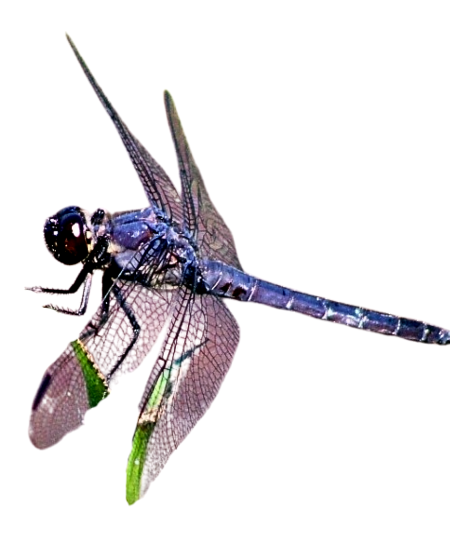
In general, Dragonflies are recognizable by their large heads, prominent bulbous compound eyes, and short antennae. It has a short thorax and a long, thin abdomen, and appears in a range of bright and drab colours depending on the species (in Nova Scotia, common colours are green, blue, brown, and black). Dragonflies have six legs positioned near the front of the body and four transparent wings with a vein-like pattern, which include dark spots in some species.
Adult Dragonflies are almost always found near relatively clean sources of freshwater. Wetlands are especially ideal habitats as cattails and other tall plants provide perching spots and shelter (especially for nymphs). Since Dragonflies lay their eggs in the water, they must stay close to water sources to successfully reproduce. In turn, adult Dragonflies feed on other flying insects that emerge from these water sources. The distribution of Dragonflies spans every continent on Earth (excluding the Antarctic), even including the Arctic! For example, there are over 30 species in the Northwest Territories.
Dragonflies are effective carnivorous predators both in water and in the air. In the water, nymphs hunt small aquatic animals like insect larvae, shrimp, even tadpoles and small fish using their rapidly extendable lower jaw. In the air, adult Dragonflies hunt for almost any flying insect (mosquitoes, flies, wasps, other dragonflies, etc.) either by intercepting them midair (larger dragonfly species) or by ambushing as their prey approaches (smaller dragonfly species).
Dragonflies lay their eggs in, or near, freshwater sources among plant material like stems, leaf litter, and decaying wood. After hatching, the dragonfly develops into an aquatic larva (nymph) and will stay in this stage for most of its life (a few months to up to 5 years*). As temperatures rise and daylight lasts longer, nymphs leave the water in spring/summer and climb onto nearby surfaces to shed their final moult (dragonflies moult 5-15 times over their life*), after which their wings and bodies harden before taking flight. In contrast to their long development, adult dragonflies live for only a few weeks to months.
*Depending on species.
Adult Dragonflies have several adaptations that make them effective fliers, to hunt prey and avoid predators. They have five eyes in total, two large compound eyes (for almost 360° vision) and three small, simple eyes that likely help to keep the Dragonfly upright in the air. Their four wings are attached directly to muscles in the thorax, allowing Dragonflies to fly faster and with more control than most insects. As aquatic nymphs, Dragonflies have a gill chamber at the end of their digestive tract that can draw in and expel water for respiration and propulsion. Put simply, Dragonfly nymphs use their rear end to breathe and move!
In Mi'kmaq culture, the Dragonfly represents change and transformation reminding us to adapt and see from new perspectives. They are also messengers providing a connection to a loved one who has passed away.
Dragonflies have existed since tens of millions of years before the dinosaurs. One extinct ancestor of the Dragonfly, the Meganeura genus, had a wingspan of almost 75cm (2.5 feet)!
A dragonfly’s vision is almost panoramic, with its compound eyes providing tens of thousands of visual signals to detect movement in every direction.
Dragonflies do not have a sense of hearing.
Dragonflies can reach flight speeds of 48 km/h (30mph).
The efficiency of Dragonfly flight has inspired aircraft design research, such as mimicking their wing structure to potentially create lighter, more cost-effective airplane wings.