American Eel
Mi'kmaq Name: Katew
Scientific Classification
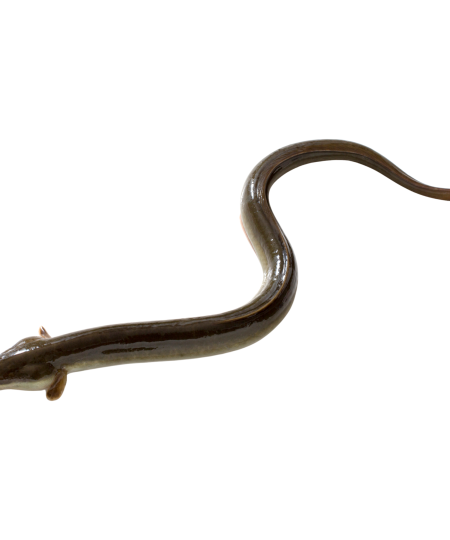
Predominantly freshwater, this eel migrates to saltwater to breed (catadromous). They have a slender, snakelike body covered with mucus. A long dorsal fin runs from the middle of the back and is continuous with the ventral fin. Colour ranges from olive green to brown to greenish yellow with the ventral surface being gray or white. Eels in clear water tend to be lighter in colour or shading than those in darker waters. American Eels can grow up to 1.2 meters (4 feet) long and weigh up to 7.5 kg (17 lbs). Females are generally larger than males and will reach sizes closer to the 1.2 meters (4 feet) maximum. Males max out at about 60cm (2 feet) on average.
American Eels are found in all accessible freshwater ecosystems from a latitudinal range of 5 to 62 degrees North. This has them occupying freshwater waterways and water bodies from Venezuela to Greenland including Iceland. The larval and adult phases traverse the Sargasso Sea as well as waters of the Atlantic Ocean to start and complete the life cycle respectively. The eels are bottom dwellers hiding in burrows, tubes, masses of vegetation, crevices and other shelters. They are found in streams, rivers, lakes, coastal bays and estuaries. In their growth phase, they are capable of migrating between freshwater and brackish to saltwater to feed. They spend variable times in each of these habitats depending on factors such as age, food availability, season, and predation. For winter, eels burrow into the mud and enter a state of torpor (hibernation), that they may come out of occasionally.
Carnivores, mainly eating crustaceans, aquatic insects, fish, molluscs but their diet changes during their life cycle and with the seasons.
American Eels are catadromous, moving from freshwater habitats to the ocean to spawn. The cycle starts when the eels hatch in the Sargasso Sea as "leptocephali" which are small, transparent, leaf-shaped larvae that drift in the current, feeding on microorganisms as they develop. After a year, leptocephali molt into a transparent, miniature eel referred to as the "glass eel". Glass eels find the coastline using their keen sense of smell before molting again upon reaching freshwater. Glass eels molt to become "elvers", small pigmented eels that swim up fresh waterways in search of their preferred freshwater habitat. Along their journey, elvers adapt to their changing environment and feed on small aquatic organisms. Elvers mature into "yellow eels", a phase that lasts anywhere between 3 and 30 years. This is the main phase of the American Eel and the one that humans target when fishing. Yellow eels live in fresh and brackish water and during this growth phase, may attain a length of 1.2 meters (4 feet). When they reach sexual maturity, yellow eels transform to "silver eels" that are characterized by darker bodies and larger, well developed eyes. It is this phase that migrates back to the Sargasso Sea via the Atlantic Ocean. Once there it will spawn, completing the life cycle before dying.
Their colouration enables camouflage with their background and their shade lightens or darkens depending on the clarity of the water. They have very small, tightly packed scales, giving their skin a smooth and polished appearance reducing drag when swimming. American Eels secrete large amounts of mucus keeping their skin moist and allowing gaseous exchange across the skin for short periods when out of the water. Their body shape, muscle composition and ability to swim backwards, make it a powerful predator capable of maneuvering tight spaces when hunting.
In Mi'kmaw culture, Eels are an important food source and their oil is used for medicine and skin for tools and bindings. They are honoured in such ceremonies as they mid-winter feast and reflect the importance of maintaining respectful relationships with all species.
Most females lay between half a million up to 4 million eggs. Large females have been known to lay as many as 8.5 million eggs. Eels are semelparous which means they only mate once in their lifetime. Indeed! This means that after spawning, the adult eels die.
American Eels are able to navigate through very small streams and even use wet grass to get between waterbodies when looking for appropriate habitat to live or to hunt. They are able to perform gaseous exchange through their skin if needs be during this time.
Being catadromous (living in freshwater and migrating to the sea to spawn), American Eels must traverse thousands of kilometers, including swimming upstream, through dams and various other obstacles, at the start and again at the end of their life cycle.
A big change between the yellow and silver eel phases is that of the eyes. The yellow eel phase has tiny eyes as it lives in shallow, freshwater that light can easily penetrate through allowing it to see. The silver eel phase lives at greater depth in saltwater where light is a lot dimmer. The result is silver eels having eyes that are 10 times larger than the previous phase to help them navigate, yet they still have far poorer eyesight.
At first glance, American eels do not seem to have scales. Unlike other fish, the scales of the American Eel are embedded well below the epidermis of the skin. The scales are also very small and under magnification they do not overlap but appear in a basket-weave type of pattern. They are not continuous but exists in select sections of the animal. Finally, American Eel skin produces copious amounts of mucus to reduce drag when swimming, to facilitate its burrowing lifestyle, and to limit the chances of a predator being able to grab it. All these facts contribute to the eel looking like it does not have scales.