Green Frog
Mi'kmaq Name: Sqolj (pronounced ess-hold-ch)
Scientific Classification
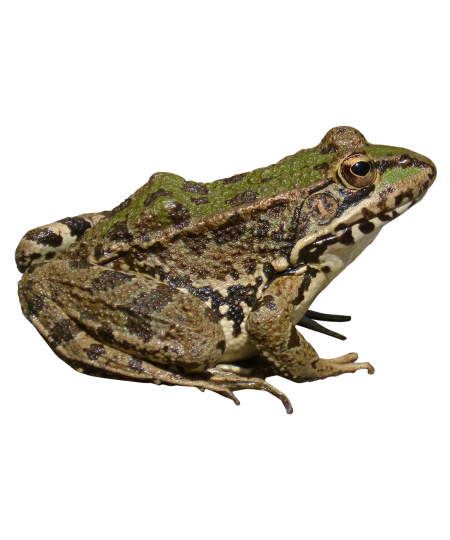
A mid-sized true frog ranging from 5 to 10 cm (2-4 inches) in length and weighing 28 to 85 grams (1-3oz). Adult females are larger than adult males. Adult males also have eardrums or tympania that are twice the size of its eye. Female eardrums are the same size as the eye. Green frogs usually have green heads while the body is brown, gray or dark green. The green on the head may be on the sides or all the way down the back. Bellies are white with dark mottling. Males in their breeding condition present with a yellow chin.
Widespread species native to North America and mainly found in Southeastern Canada. They are fond of shallow freshwater ponds, roadside ditches, lakes, swamps, streams, vernal pools and other temporary water bodies. They establish home ranges around these water bodies where they forage in leaf litter and dense vegetation before returning to the water body for shelter and safety.
Carnivores, feeding on invertebrates such as beetles, moths, flies, slugs, worms, spiders, fish, shrimp, crayfish and other amphibians. They are sit-and-wait predators. Tadpoles eat mainly microscopic plant matter like diatoms and algae, plus small quantities of microscopic animal material including zooplankton and copepods.
Females lay their eggs in the territory of the male and could mate and lay eggs twice in a year starting in spring. After hatching, tadpoles (the larval stage) last for 70 to 360 days depending on the time of year the eggs were laid. If the eggs hatch later in the year, tadpoles are capable of hibernating over the winter and metamorphosing to frogs (the adult stage) the following spring. Green frogs become sexually mature after one year though they tend not to be sexually active until the year after they are sexually mature. They live for 5 to 10 years in the wild and often exceed 10 years in captivity.
Green frogs hibernate during the winter as a way to survive very low temperatures and limited food availability. Hibernation is made possible through the presence of antifreeze chemicals such as glucose and glycerol that prevent cells from freezing and suffering damage during the cold winter. Green frogs have multiple respiratory surfaces. Apart from lungs in adults, the larval tadpole possesses gills. Adults are also able to perform gaseous exchange across their skin and buccal cavity. Another key adaptation is their ability to adjust their coloration and shade to blend in with the environment (camouflage) making it very difficult for predators and prey to spot them. Finally, to help with its territorial displays, finding a mate, and escaping predation, the green frog's hind legs are powerfully built allowing it to jump up to 2.1 meters (7 feet).
In Mi'kmaq culture, Frog calls represent a shift in seasons and are used as indicators within the natural environment. Within the 13 moon calendar, Sqoljui'ku's (Frog Croaking Moon) is roughly in May-June when frogs are most active, their chorus of croaking signaling the arrival of spring, a time of renewal and growth.
Green frogs get darker on colder days to help absorb heat.
The green frog is well known for its vocalization, sounding like a plucked banjo. It uses this as a mating call and also to defend its territory.
Research has shown that green frogs are able to undergo sex/gender reversal in both contaminated, suburban areas as well as pristine, undisturbed areas.
Green frogs sometimes have a genetic mutation called xanthism in which it is unable to produce yellow pigmentation. Just like mixing paint, the yellow pigmentation added to the blue, makes the green looking frog. Absent of the yellow pigmentation, the frog is seen as blue.
Kermit the frog is modeled after the green frog.