Black Ash
Mi'kmaq Name: Wisqoq (pronounced whist-ko)
Scientific Classification
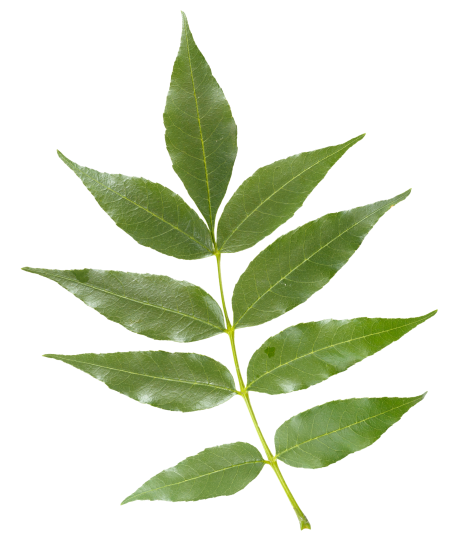
Black Ash is a hardwood tree that is typically 15 to 20 meters (49 to 66 feet) tall with a 30 to 50 cm (1 to 1.6 foot) trunk diameter. A single leaf is made up of 7-11 oval-shaped leaflets that are uniquely attached directly to the stem (no stalk), arranged in pairs along the stem with a single leaflet at the end. Its bark is rough and scaly, with a light gray colouration. Black Ash can be distinguished from other ash species by its seeds, which are contained within samaras (commonly known as whirligigs) that have a leaf wing that’s noticeably wider at the base.
Black Ash is a species associated with wetland habitats, namely swamps and bogs, as it typically grows in peat-rich or loose, waterlogged soils that are alkaline and rich in nutrients. The distribution of Black ash extends from the southeastern tip of Manitoba to the Maritimes, where it is widespread. Its southern range spans Maine to eastern Iowa, with the species’ overall distribution being roughly even between Canada and the United States.
Black Ash trees are autotrophs, meaning they create their own food (sugars) using sunlight, water, and carbon dioxide through photosynthesis. While Black Ash is not known to have unique nutrient needs, its tendency to grow in alkaline soils suggests it can tolerate the lower availability of phosphorus and micronutrients that is typical to these conditions.
In late spring, Black Ash trees develop flowers that are wind pollinated. Once fertilized, these flowers develop into winged seeds (samaras, or “whirligigs”) which are dispersed by the wind. If these seeds land in a suitably moist environment, they must pass through several stages of dormancy before they can germinate, which is triggered by seasonal changes in temperature. Only then, typically in the second year after dispersal, will a seed begin growing into a mature tree, a slow process that takes 30-40 years.
As Black Ash tends to grow in wetlands, they have several adaptations for surviving in waterlogged soils. Plant roots need oxygen for respiration, so the Black Ash has a shallow root system that’s closer to the soil surface, where oxygen is more available. However, this also makes the roots more vulnerable to damage, so these roots regrow quickly to compensate. Additionally, the root cells involved in gas exchange are larger so that more oxygen can enter, helping to counteract the low-oxygen conditions of waterlogged soil.
In Mi'kmaq culture, Black Ash is a vital resource used to make snowshoe frames, canoe ribs, instruments, and most importantly basket making. Traditional basket making is a blend of function, art and identity. Black Ash reflects the importance of skill, patience and passing knowledge through generations.
A Black Ash tree can produce 2 to 1,500 seeds in a single year.
The lifespan of a Black Ash tree reach up to 300 years.
Black Ash seeds are a food source for many types of wildlife, including squirrels, ducks, and songbirds.
Black Ash are listed as Threatened in Nova Scotia and Canada due to a recently introduced pest the Emerald Ash Borer which is spreading and causes widespread mortality to the trees. Research and experiments in biological controls are ongoing.