Cattails
Mi'kmaq Name: Poqomaqn’skw (pronounced boho-mon-a-nes-quik)
Scientific Classification
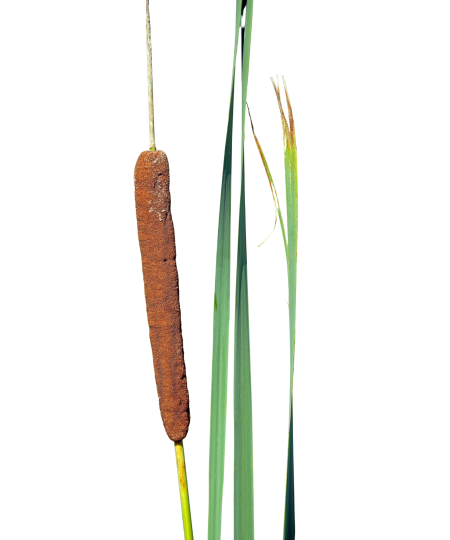
The cattail is a semi-aquatic, herbaceous, perennial plant that growth to height of 0.7 to 2.5m (2.5 to 8ft) in height. Its leaves are long and narrow (up to 2.5cm or one inch wide) and attached to a jointless stem that also bears the commonly known flowering spikes called catkins. The female catkin consists of numerous female flowers bunched together in a sausage-shaped structure. The male catkin sits atop the sausage. Once the male's pollen is shed, the supporting parts wither away. After fertilizatiion, the female catkin forms minute seeds that are attached to the plant by tiny hairs. When the seeds are ready, the structure breaks down into a cotton-like fuzz that is ideal for dispersal by wind.
Found commonly across the temperate and cold regions of the northern and southern hemispheres, cattails are found at the water's edge of fresh and slightly brackish water systems. There are as many as 30 different species of cattails and they are a hardy species that tends to outcompete other species in the niches where they are found. They thrive in marshes, swamps, along rivers and in other wetlands, growing from a depth of 30cm to 1.2m (1 to 4ft). They are also comfortable in disturbed habitats and are commonly found growing in ditches and gullies in urban areas.
Cattails are autotrophs, meaning they create their own food (sugars) using sunlight, water, and carbon dioxide through photosynthesis. They also require nitrogen, phosphorus and potassium rich soils to help them grow tall and fast.
During winter, cattails exist as underground rhizomes which are high energy storage stems. As the temperature rises after winter, new cattail plants or shoots begin to grow. Shoots grow rapidly and in a matter of a few weeks can be over 2.5m (8ft) tall. By late spring to early summer, the plant starts producing flowers. Male and female flowers grow on the same stalk with the male sitting atop the female. To ensure that the male does not fertilize the female, the male matures first, its pollen is dispersed, and it quickly withers away thereafter. The female flowers are fertilized after and seeds are produced. Once mature, seeds are dispersed via wind or water. Seeds that are deposited in suitable habitat grow into a new plant that take a year or two to mature. Mature cattails also reproduce asexually, producing rhizomes that spread around them giving rise to more cattail plants.
Extensive underground rhizome system keeps cattail stands anchored in the substrate, and to each other, keeping them fixed in waterlogged soil. The rhizome system is also essential for its survival during winter months and facilitates rapid growth during the spring so that the plant can reestablish itself and outcompete competitors. They have light-weight fluffy seeds that are easily dispersed by wind and water allowing them to be distributed far and wide. Leaves, stems and roots are packed with a spongy, air-filled tissue called aerenchyma. Aerenchyma allows air that enters the plant through the parts that are out of the water and exposed to air, to be easily transferred to the parts of the plant that are underwater thereby facilitating gaseous exchange throughout the plant. The presence of aerenchyma also keeps the plant buoyant which is beneficial for its semiaquatic lifestyle.
In Mi'kmaq culture, Cattails have been used for food, medicines and to make mats, clothing and fire starters. Nearly every part of the plant was used helping to remind us to only take what is needed from the environment and to use all parts. They teach respect for the land, resourcefulness, and value in living in balance with the natural world.
Cattail material has very versatile uses in many cultures. Some of the more outstanding uses have been paper, rope, pillows and even medicine. In World War II, cattail material was used in vests because it was a good insulator and also very buoyant.
Cattails filter and purify water. Their roots absorb excess nutrients and pollutants making them essential to the health of wetland ecosystems and providing clean water for animals including humans.
Cattails grow very quickly and can grow almost a meter (3ft) in 16 days after being planted. The average cattail will grow 2 to 2.5m (7 to 8ft) in height, but in ideal conditions, cattails can grow up to 3 meters (10ft) high.
Other names for cattails include bulrushes, reeds, reedmace, cumbunji, punks, raupo