Red-winged Blackbird
Mi'kmaq Name: Mekwe'k wnisqi'k putali'skiej
Scientific Classification
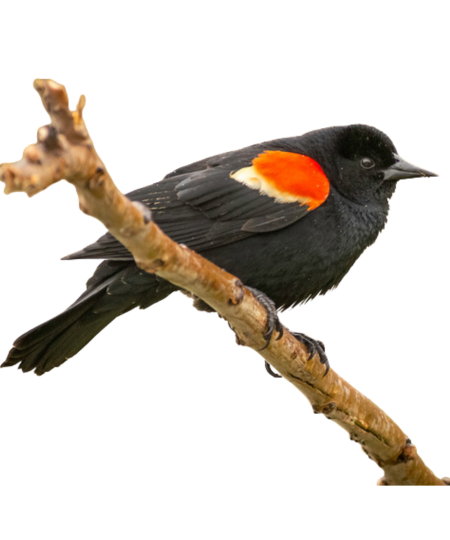
Breeding males are entirely black other than a red patch on their shoulder which is edged in yellow. Their pointed beaks, perching legs and eyes are all black. During non-breeding season the male's shoulder patch is fainter and the black more mottled. Adult females and juveniles look almost like sparrows being a mottled brown all over and a beige face that has a dark bar through the eye. They have a yellowish patch on their chin and their beaks and legs are grey-brown. Their bodies are 15 to 25cm (6 to 10in) in length with a wingspan of 30 to 41cm (12-16in). Males weigh on average 65g (2.3oz) and females 43g (1.5oz).
One of the most abundant birds in North America, they can be found year around through most of the mainland of the US down through Mexico to Costa Rica. During breeding season they live throughout most of the Canadian provinces, keeping to the southern parts of Quebec and Ontario, but in western Canada expanding up into the southern parts of the Northwest Territories and the Yukon. Their preferred habitat is marshes, either freshwater or saltwater. They will also live in other wetlands, along river shores or ocean coasts, as well as in fields and meadows including argicultural land like rice paddies, and developed areas like roadside ditches or urban parks.
Omnivores, eating mainly insects in the summer then switching to seeds and grains in the fall. Some of their favourite insects are: dragonflies and damselflies, beetles, flies, caterpillars and grasshoppers . Their favourite grains are: rice, corn, wheat, sunflower and oats. The forage on the ground picking through the vegetation.
Breeding takes place in the spring with males displaying their red patches and singing to attract females and set-up a territory. Males will take multiple mates (typically 2-4 but up to 15) and so will females. Nests are made of plants and mud and are built near the water hidden low in dense vegetation. Females incubate the 2-5 eggs and do most of the feeding of the hatchlings (males will help feed but not incubate) but both parents defend the nest. These birds are extremely protective of their nests attacking potential predators, including humans, who come too close. They will call loudly, hover, then dive to attack, chasing away the threat. Their main predators are: crows, magpies, grackles, mink and raccoons. Another threat is the Brown-headed Cowbird that might paratize the nest by laying their own eggs for the Red-winged Blackbird to raise, the cowbird chicks outcompeting the blackbird chicks or even rolling the unhatched blackbird eggs out of the nest. Young blackbirds fledge after around two weeks and females might have a second brood if conditions are favourable. Their life expectancy is around 2-3 years.
Strong and agile fliers with some populations migrating 600 to 1000km (400 to 600miles). Roosting together in flocks at night, during the day they might travel 80km (50mi) to forage for food. Communication is important for this social bird making a variety of sounds including chirps, clacks, peeps, whistles, screams and buzzing. They are adept at foraging on the ground in marshes by picking through leaves and grasses, turning over sticks, and prying open aquatic plant stems to get to insects hiding inside. The bright-red shoulder patches on the males can be hidden by surrounding body feathers for camouflage.
In Mi'kmaq culture, Red-winged blackbirds represent seasonal change particularly the arrival of spring and return of abundance to the land and are respected as a part of the wetland ecosystem.
These birds communicate with a variety of noises including chirps, peeps, clacks, whistles, screams, and buzzing. But the male song is readily identifiable being a few short notes ending with a trill that sounds like "conk-a-ree". Females with chirp and chatter along with the song creating a duet.
During migration Red-winged Blackbirds will flock together with other blackbirds like Common Grackles and Brown-headed Cowbirds as well as Starlings creating flocks of millions of individual birds.
Their nests are sometimes parasitized by Brown-headed Cowbirds who do not build their own nests instead laying their eggs in the nest of the Red-winged Blackbird to unwittingly raise as their own. Young cowbirds sometimes even roll unhatched blackbird eggs out of the nest.
Subspecies of Red-winged Blackbird vary in colour which was found to be caused by the environment not genetics as nestlings from different populations were experimentally swapped to find that the young grew up to resemble their foster parents.
Males will defend a territory with 90% of males having more than one female nesting in their territory. But the females also take multiple mates with studies finding that 25-50% of the nestlings are not related to the male defending the territory.