Wild Rice
Mi'kmaq Name: Aptelmultimkewe'l (pronounced app-chel-mul-tim-ge-way)
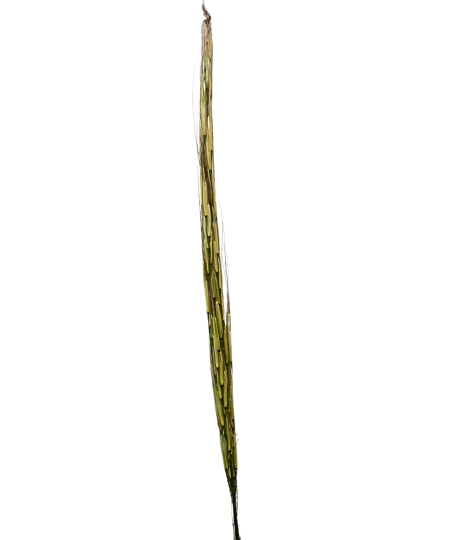
Scientific Classification
Annual grass that ranges from 1 to 3 meters (3 to 10 feet) tall. They thrive in water that is a few centimeters to up to a meter (inches to 3 feet) deep with best growth occurring at the deeper end of the range. It produces three types of leaves, submerged, floating and aerial. Submerged leaves are produced first and remain underwater. Floating leaves appear a few weeks after and are spongy, containing air that allows them to float at the surface. Soon after the floating leaves are produced, aerial leaves emerge and range from 30 cm to 1.2 m (1 to 4 ft) in length. Leaves are 3.8 to 5 cm (1.5 to 2 in) wide. Leaves are also hairless but fine-toothed and capable of breaking skin.
Wild rice grows on fresh to brackish riverbanks, shallow lakes, and slow-moving streams, often forming large monocultures. It thrives in water less than 60 to 90cm (2 to 3 feet) deep with a slight current and a substrate type of silty or mucky. It does not do well in sandy substrates. The species is native to the eastern United States and southern Canadian provinces, with documented populations from Quebec and Nova Scotia southward to Florida and Louisiana.
Wild Rice are autotrophs, meaning they create their own food (sugars) using sunlight, water, and carbon dioxide through photosynthesis. They also prefer a soil with peat or clay that remains submerged in water and doesn't ever dry out.
During the late autumn/early winter, mature seeds fall into the water and sink to the bottom, settling into the soft silt or mud. They remain dormant there for the winter. In the early spring, as soon as the ice melts, seeds germinate in the icy cold, shallow water. Seedlings push out long, narrow, submerged leaves. Later in spring and to early summer, the plant produces floating leaves that have a thick, waxy, waterproof cuticle. This is a particularly vulnerable part of the life cycle as plants are easily uprooted by moving water and fluctuating water levels. Having survived the floating leaf stage, the plant transitions to the aerial stage by mid-summer developing strong roots, aerial leaves and a hollow stem that grow vertically as tall as 3 meters (10 feet). In mid to late summer (July - August), a single flower containing both male and female parts is produced. Male and female parts mature at different times to prevent self pollination and promote cross pollination. In late summer/fall after pollination, female flowers develop seeds that mature in 10 - 14 days. Late in the fall, seeds shatter and fall into the water to be dispersed and repeat the cycle. Once seeds are shed, senescence takes place where the plant withers, turns brown and dies.
Wild rice have very high energy storage in their seeds, capable of getting the seedling through root and submerged leaf production until it can produce energy for itself. Germination is triggered only after a period of dormancy and when the ice breaks ensuring that the plant begins to grow as soon as the water begins to warm up. Their unique leaf production (submerged, floating and aerial) facilitates energy production at varying water levels. Leaves, stems and roots are packed with a spongy, air-filled tissue called aerenchyma. Aerenchyma allows air that enters the plant through the parts that are out of the water and exposed to air, to be easily transferred to the parts of the plant that are underwater thereby facilitating gaseous exchange throughout the plant. The presence of aerenchyma also keeps the plant buoyant which is beneficial for its semiaquatic lifestyle.
In Mi'kmaq culture, wild rice was an important food source eaten fresh, stored for winter and ground into flour. It would be harvested from a canoe with one person rowing and the other using wooden sticks to knock the seeds into the canoe. Any grains that fell back into the water was left to regrow. To remove the hulls, people would dance over the dried rice to separate or loosen it without damaging the grains. Wild Rice represents the adundance found in wetlands and the importance for caring for ecosystems that sustain both people and wildlife.
Wild rice has moderate fire tolerance, an adaptation that allows it to outcompete woody species in areas that are impacted by fire
Normally found in freshwater, it also has moderate tolerance for brackish water. Though the mature plants can live in brackish conditions, germination of seeds is negatively affected the more salty the water is.
It is not a true rice but is the seed of a semi-aquatic grass.
It is an annual plant living its entire life cycle in a year. It does not grow from a bulb or rhizome that has a headstart from the previous season, but as a brand new plant every spring.
Other names for wild rice include manoomin, annual wild rice, Canada rice, Indian rice, wild oats, water oats, black rice, marsh oats, blackbird oats.